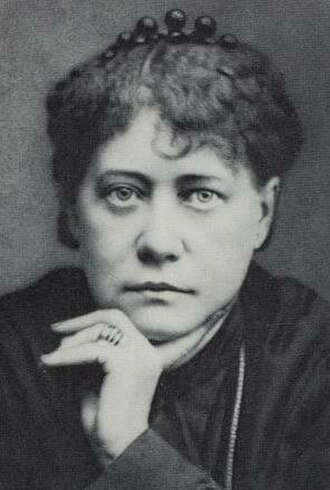
 AuthorHelena Blavatsky1831–1891
The Secret Doctrine, subtitled The Synthesis of Science, Religion and Philosophy, is one of the most influential works of Helena Blavatsky, founder in 1875 of the Theosophical movement. It appeared in 1888, published simultaneously in London and New York, in two volumes: the first devoted to cosmogenesis and the second to anthropogenesis. Blavatsky wrote it between 1884 and 1885, rewrote much of it afterwards, and completed it in London in the spring of 1887, when she was recovering from a serious illness that, by her account, left her with the choice between dying and continuing the work.
The author claimed that the book rested on the so-called Book of Dzyan, an ancient manuscript written in the language of Senzar that has never been located, together with Hindu, Buddhist, Jewish and Chaldean texts and ancient mythology. She also maintained that she was not the author in a strict sense, since the content had been transmitted to her by the Mahatmas. Her stated aim was to show that an original religion existed from which all traditions descend, and that the insights of ancient sages anticipated discoveries later claimed by materialist science.
The first volume describes the origin and evolution of the universe through cycles of activity (manvantaras) and rest (pralayas) of immense duration, drawing on Hindu cosmology. Its basic principles are the existence of an unknowable Absolute Principle, the universal periodicity of manifestation and dissolution, and the ultimate identity of every soul with the Universal Soul. The second volume recounts the origin of humanity through successive "root races" said to have lived on lost continents such as Lemuria and Atlantis, and argues that real evolution does not follow the Darwinian line.
Today the work is regarded as an example of the renewed interest in esotericism in the modern age and as an attempt to reconcile Eastern wisdom with science. It has been criticized for its pseudoscientific character and for borrowing ideas from other systems without acknowledgment. After Blavatsky's death, Annie Besant published a third volume in 1897 prepared from her papers, and the whole was widely circulated in later editions.
Themes
Books to read
- The Secret Doctrine, Vol. 1 of 4 The Synthesis of Science, Religion, and Philosophy EnglishEPUB 1,0 MBRead online
- The Secret Doctrine, Vol. 2 of 4 The Synthesis of Science, Religion, and Philosophy EnglishEPUB 1,3 MBRead online
- The Secret Doctrine, Vol. 3 of 4 The Synthesis of Science, Religion, and Philosophy EnglishEPUB 860 KBRead online
- The Secret Doctrine, Vol. 4 of 4 The Synthesis of Science, Religion, and Philosophy EnglishEPUB 2,1 MBRead online
Original Filopedia text based on Wikipedia (es) and Wikipedia (en) and Wikidata.