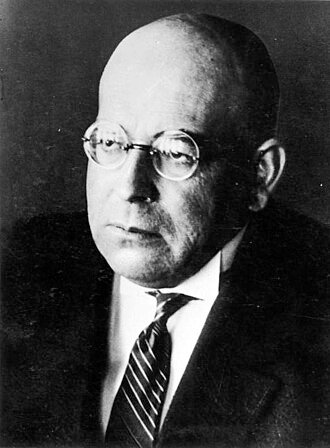
 AuthorOswald Spengler1880–1936
The Decline of the West is a two-volume work by Oswald Spengler, written in German. The first volume, subtitled Form and Actuality, appeared in the summer of 1918; the second, Perspectives of World History, followed in 1922, and the definitive edition of both came out in 1923. Spengler had drafted the book around 1911 and revised it at the outbreak of the First World War, whose atmosphere shaped its tone. It was his first major work, apart from his doctoral dissertation on Heraclitus.
Spengler proposed what he called a Copernican overturning of historical thinking. He rejected the Eurocentric division of history into ancient, medieval and modern, and argued that the meaningful units are not epochs but whole cultures, which he treated as organisms. Each culture passes through a life cycle of roughly a thousand years of flourishing and another thousand of decline. In his scheme a culture begins as a race, becomes a true culture as it produces new insights, and finally hardens into a civilization, a phase marked by military expansion and self-assurance that accompany the loss of creative energy. To illustrate, he placed the Classical culture in early Greek thought, its civilization in Roman expansion, and its decline in the collapse of the Roman and Byzantine empires. He distinguished at least eight high cultures: Babylonian, Egyptian, Chinese, Indian, Mesoamerican, Classical or Apollonian, Magian (the non-Babylonian Middle East, including Judaism, Christianity and Islam) and Western or Faustian.
His central claim was that the West stood in its final phase, comparable to the late Roman Empire, and that its decline would be a slow, protracted fading rather than a sudden catastrophe. Spengler later explained that the German title suggested sunset more than collapse, and that the word "decline" had caused misunderstandings. His method, which he called the comparative morphology of cultures, sought the structural forms of each civilization rather than its functions.
The book had a vast impact in Germany between the wars, where it was read as a diagnosis of profound crisis, and it provoked debate across Europe. Its prophetic tone and predictions were widely contested by historians and philosophers, who criticized its speculative biological analogies and the arbitrariness of its comparisons.
Themes
Books to read
Original Filopedia text based on Wikipedia (es) and Wikipedia (en) and Wikidata.