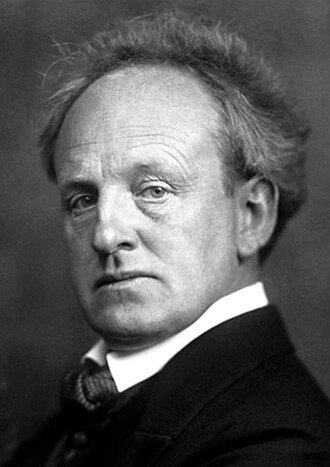
 AuthorGerhart Hauptmann1862–1946
The Assumption of Hannele (German: Hanneles Himmelfahrt), also known simply as Hannele, is an 1893 play by the German playwright Gerhart Hauptmann. Unlike his naturalistic dramas, it adopts a more symbolist dramaturgy and includes a dream sequence. It is the first work in world literature to have a child as its heroine.
The play tells the story of a neglected and abused peasant child who, on her deathbed, has a vision of divine powers welcoming her into the afterlife. It was first published in 1894, and in 1896 Hauptmann received the Grillparzer Prize for it.
It premiered at the Königliches Schauspielhaus in Berlin on 14 November 1893, directed by Max Grube. Constantin Stanislavski staged it in Moscow, and Vladimir Nemirovich-Danchenko wanted it in the first season of the Moscow Art Theatre, but the production was banned after protests by the Russian Orthodox Church, despite having passed the censor.
Themes
Other works by Gerhart Hauptmann
- The Weavers 1892
- The Rats 1911
Original Filopedia text based on Wikipedia (en) and Wikidata.