Institutiones divinarum et saecularium litterarum
Christian encyclopedic treatise · 560
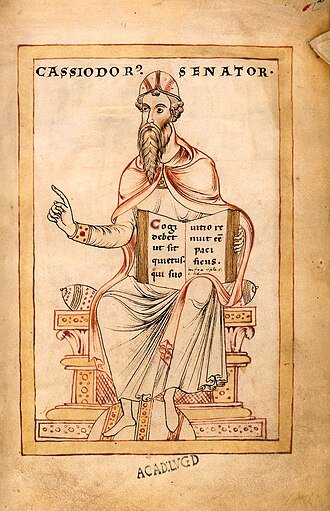 AuthorCassiodorus487–583
The Institutiones divinarum et saecularium litterarum (Introduction to Divine and Human Readings) is a work by Cassiodorus, generally regarded as the first Christian encyclopedia. Composition began around 550, and the author never considered it finished: he kept expanding it until his death some thirty years later. It is divided into two books, the first devoted to the Scriptures and the second to the liberal arts.
The title is directly inspired by Quintilian's Institutiones oratoriae, and the project aims to adapt a wide range of classical Greek and Latin treatises to the new Christian context. Isidore of Seville and Alcuin of York pursued a similar aim later, both of them readers of Cassiodorus. The second book contains a guide to the seven liberal arts, treated very unevenly: rhetoric and dialectic take up more than half the text, perhaps a reflection of the author's Roman education. Grammar draws on Donatus; rhetoric on Cicero and commentators such as Marius Victorinus; dialectic on Porphyry and Aristotle. Arithmetic, music, geometry and astronomy are presented more briefly.
The work's originality lies in its character as a teaching manual: alongside the basic concepts of each discipline, it offers the bibliography needed to study them. Its scheme of seven arts was later consolidated as the trivium and quadrivium, the foundation of teaching in monastic, cathedral and palace schools and, later, in medieval universities. The compendium soon circulated as an independent work under the title De artibus ac disciplinis liberalium litterarum and enjoyed wide diffusion, as the large number of surviving copies and commentaries attests.
Themes
Other works by Cassiodorus
Original Filopedia text based on Wikipedia (es) and Wikidata.