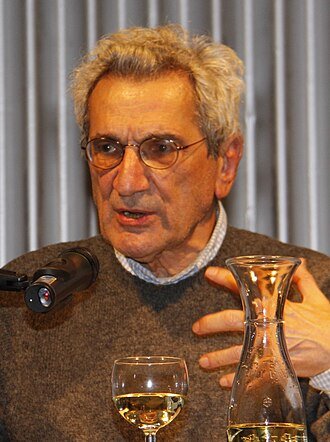
 AuthorAntonio Negri1933–2023
Empire is a book by the philosophers Michael Hardt and Antonio Negri, written in the mid-1990s and published in 2000. It sold well beyond what is usually expected of an academic work, and it gained a notoriety rare for a text of this kind.
Its central thesis describes a shift from modern imperialism, organized around individual nation-states, toward a postmodern form of rule that the authors call Empire, with a capital letter, built among the dominant powers. In this new order, conflict between nations loses its significance, and the enemy is no longer ideological or national but takes on something close to the figure of a criminal: at once trivialized by routine police repression and absolutized as a threat to the ethical order. The book arranges power in three levels that recall Polybius's account of Roman government: a monarchy formed by the United States, the G8 and organizations such as NATO, the International Monetary Fund and the World Trade Organization; an oligarchy of multinational corporations and other states; and a democracy represented by various NGOs and the United Nations. Within this framework, resistance is hard to imagine, and the authors conceive it mainly as negation, a will to be against. Economic inequality persists despite the apparent universality of Empire, and the identity of the poor survives.
The book draws heavily on Michel Foucault, especially his analysis of biopolitics, and on Gilles Deleuze and Félix Guattari, whose notions of multiplicity, deterritorialization, nomads and control underpin much of its argument. Before writing it, Negri was best known for The Savage Anomaly (1981), a study of Spinoza he wrote in prison, and the concept of the multitude, which Hardt and Negri later developed in Multitude (2004), Commonwealth (2009) and Assembly (2017), also comes from Spinoza. Other influences include Carl Schmitt, for his theory of sovereignty, and Machiavelli.
The work received wide and polarized attention. The London Review of Books called it the most successful work of political theory to come from the Left in a generation, and some critics described it as a bible of the anti-globalisation movement. Slavoj Žižek said it aimed to write the Communist Manifesto for the twenty-first century, though he criticized it for not linking its radical demands to the inherent antagonisms of capitalism that would make them achievable.
Themes
Original Filopedia text based on Wikipedia (es) and Wikipedia (en) and Wikidata.