The General Idea of the Revolution in the Nineteenth Century
political manifesto and treatise of anarchist philosophy · 1851
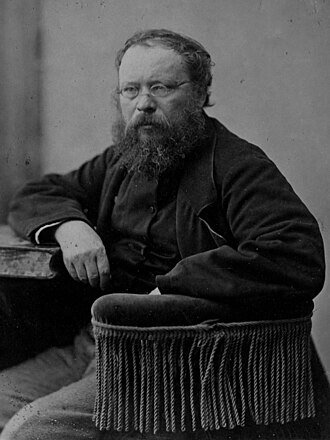 AuthorPierre-Joseph Proudhon1809–1865
The General Idea of the Revolution in the Nineteenth Century is a manifesto written in 1851 by the French philosopher Pierre-Joseph Proudhon, who composed it while serving the last year of a prison sentence begun in 1849 for criticizing Louis-Napoleon Bonaparte, whom he regarded as a reactionary. The book appeared in July of that year; its first edition of 3,000 copies sold out quickly, and a second followed in August.
The book sketches an ideal society of a federal character, without frontiers or nation states, in which there would be no central authority or governing law. Power would rest in communes and local associations, regulated by contractual law. Its central thesis is that revolution is a historical necessity and cannot be prevented: even reaction, by resorting to ever more brutal methods to contain it, helps the revolution become conscious of itself.
Proudhon argues that the exploitative nature of capitalism is what creates the need for government, so revolutionaries must change the economic foundations of society, after which authoritarian government would become superfluous. He criticizes representative democracy, in which real power is exercised by a small number of people, and proposes turning the Bank of France into an autonomous, democratic 'Bank of Exchange', and handing railways and large industries over to their workers. Unlike the Marxists, he advocated reconciliation between the middle classes and the proletariat.
The work is regarded as one of the foundational texts of libertarian and anarchist theory, and its ideas on reciprocity and mutualism influenced later generations of thinkers and movements. Marx and Engels discussed it in their 1851 correspondence, offering critical judgments of its account of class.
Themes
Other works by Pierre-Joseph Proudhon
- What Is Property? 1840
Original Filopedia text based on Wikipedia (es) and Wikipedia (en) and Wikidata.