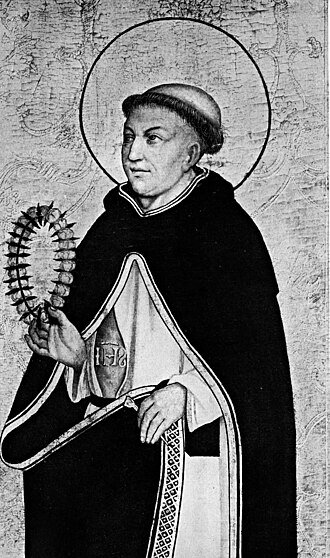
 AuthorHenry Suso1295–1366
Horologium Sapientiae was written by the German Dominican Henry Suso between 1328 and 1330. It belongs to the tradition of the Rhineland mystics and German mysticism. Suso was a follower of Meister Eckhart and, controversially, defended his writings after Eckhart's condemnation.
The book is divided into two parts. The first, of sixteen chapters, focuses on reflections on Christ's passion; the second, of eight chapters, contains a focus on Eucharistic theology. It follows the style of Boethius's Consolation of Philosophy, recording both Suso's frustrations and disappointments and offering spiritualised ways of dealing with them.
It was quickly translated into several European languages, including Middle English, where it appeared as The Seven Points of True Love and Everlasting Wisdom, and it circulated widely in French, Dutch and Italian. More than 233 medieval Latin manuscripts survive. Alongside Pseudo Bonaventure's Meditations on the Life of Christ and Ludolph of Saxony's Life of Christ, it was one of the three most popular European devotional texts of the fourteenth and fifteenth centuries.
It is also thought to have influenced the tradition that attributes to Teresa of Avila the quip "no wonder you have so few friends, Lord, when you treat them so badly", a remark that Suso makes in an imaginary conversation with God in chapter 9.
Themes
Original Filopedia text based on Wikipedia (en) and Wikidata.