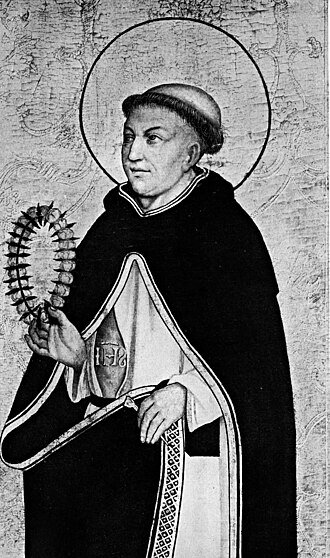
Henry Suso
1295–1366 · German Dominican mystic, disciple of Eckhart
Henry Suso (Heinrich Seuse, Latinized as Suso; Überlingen, c. 1295 – Ulm, 25 January 1366) was a German Dominican friar and one of the leading figures of the Rhineland mystical tradition. A disciple of Meister Eckhart, he formed the core of that school together with Johannes Tauler. His works, written in Middle High German and Latin, were widely read in the later Middle Ages, and he is regarded as one of the most popular spiritual writers of his time. His importance lies largely in turning Eckhart's speculative doctrine into a devotional and poetic language.
Born into the noble family of Berg, he took the name of his mother, Sus or Süs, out of humility and devotion. He entered the Dominican priory in Constance at thirteen and studied there until 1322. From 1324 to 1327 he completed his training at the Dominican studium in Cologne, where he came into contact with Eckhart. Around 1327 he returned to Constance as a lecturer, but his teaching drew suspicion because of his association with Eckhart, who was condemned for heresy after his death in 1329.
To defend his master's orthodoxy he wrote the Little Book of Truth, which softened some of Eckhart's terms to prevent misreading. He was summoned to the general chapter of 1330 and accused of heresy, though he was not condemned. He then devoted himself to pastoral work, preaching in Swabia, Switzerland, Alsace and the Low Countries, and guiding many people spiritually, especially nuns. His best-known work, the Little Book of Eternal Wisdom, mixes a dialogue between Wisdom and the Servant with a hundred meditations on the Passion of Christ. He later translated it into Latin and expanded it into the Horologium sapientiae, which circulated widely in monasteries across Europe. In his last years at Ulm he gathered his writings into the Exemplar. His thought remains within medieval orthodoxy: his mystic is a lover of Eternal Wisdom, identified with Christ, and his style gave German prose new shades for describing inner experience. His influence lasted for centuries among spiritual writers, and he was beatified in 1831.
Key ideas
- Love of Eternal Wisdom: the relationship with God is a personal, passionate love, identified with Christ.
- Meditation on the Passion: the spiritual path passes through the practical contemplation of Christ's sufferings.
- Defence of Eckhart: his writings explain his master's doctrine carefully to keep it clear of heresy.
- Moderate asceticism: bodily discipline is a means rather than an end, and he moderated it in later years.
- German mystical prose: the language of divine love allowed him to renew the vocabulary of inner sensations.
Works in Filopedia
Curiosities
A name taken from his mother
Born into the von Berg family, he adopted his mother's surname, Sus or Süs, out of humility and devotion.
Severe penances
In his youth he imposed extreme mortifications, such as an undergarment studded with a hundred and fifty brass nails; later he concluded they distracted from the love of God.
Original Filopedia text based on Wikipedia (es) and Wikipedia (en) and Wikidata.