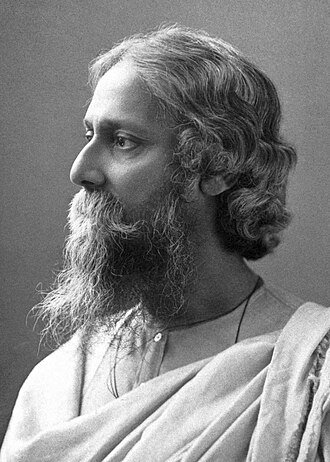
 AuthorRabindranath Tagore1861–1941
Gora is a novel by Rabindranath Tagore, written in Bengali and published in 1910. It is set in Calcutta (today Kolkata) in the 1880s, during the British Raj. It is the fifth of Tagore's twelve novels in order of composition and the longest of them all. Tagore conceived it at a time of intense public debate about religious and national identity, and its plot sits at the meeting point of traditional Hinduism and the Brahmo Samaj, the reformist movement founded in the early nineteenth century that sought to purge religion of idolatry and superstition and defended social equality and the education of women.
The book follows two parallel love stories. The first joins Gora, a young Brahmin of firm character and a fervent defender of Hindu orthodoxy, with Sucharita, a young woman raised within a Brahmo family. The second links Binoy, Gora's closest friend, with Lolita, a daughter of the same household. Through these relationships Tagore lays out in detail the debates of the period: ritual purity and untouchability, the place of women, the gap between the urban elite and rural peasants, the pressure of colonial administration, and the tensions between tradition and modernity. Gora, whose zealotry sets him against friends and relatives, gradually comes to recognise the complexity of the world he set out to defend.
The novel reaches its most dramatic point when Gora learns the truth about his birth: he is not the biological son of his adoptive father, Krishnadayal, but of an Irish Christian who died during a military conflict. This revelation undermines the identity he had built for himself and forces him to reconsider his convictions. The work closes with a gesture of reconciliation and openness, in which the search for spiritual truth prevails over religious labels.
Gora had a considerable influence on Bengali society and on Indian intellectual debate, as it was read as a meditation on what it means to be Indian under colonial rule and on how far religion can serve as an inclusive framework of belonging. Its broad structure and large cast give it the richness of a social chronicle, while its long philosophical dialogues make it as much a work of ideas as of storytelling.
Themes
Other works by Rabindranath Tagore
Original Filopedia text based on Wikipedia (en) and Wikidata.