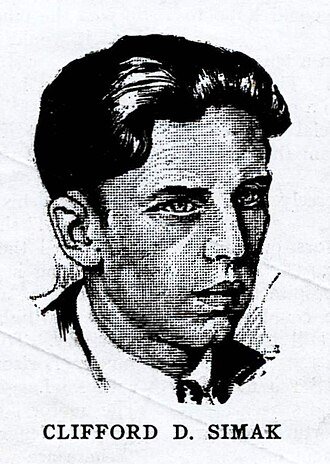
 AuthorClifford D. Simak1904–1988
Way Station is a science fiction novel by the American writer Clifford D. Simak, first published in serial form in 1963 in Galaxy Science Fiction under the title Here Gather the Stars, and in book form by Doubleday under its definitive title, Way Station. It won the 1964 Hugo Award for Best Novel. A Spanish translation appeared in 1966 from the publisher EDHASA.
The protagonist is Enoch Wallace, a veteran of the American Civil War born in 1840 who fought at Gettysburg and is later recruited by an alien he names Ulysses to run a way station for interstellar travelers. The station is installed in his own house on a family farm in Wisconsin, while he lives in a small shed attached to it. His task is to monitor the machinery, including the materializers, and to attend to the biological needs of a wide variety of visitors. Enoch does not age while inside the station, a fact his neighbors know of and tolerate without interfering. His circle of friends is small: the old mailman Winslowe Smith and Lucy, a deaf-mute young woman from the area.
The novel blends rural American life with a world of machines and extraterrestrial civilizations. Decades later the United States government discovers his existence, and the CIA agent Claude Lewis keeps him under secret surveillance for two years. The narrative gathers pace with Lucy's arrival, pursued by her father and brother, and with Ulysses bringing grave news: a Vegan's body has been dug up from the grave Enoch gave it, angering factions across the galaxy wary of human expansion, and the Talisman, an object of extraordinary power that allows contact with a universal spiritual force, has vanished. Ulysses also proposes a means of preventing an imminent world war, one that would leave humanity unable for generations to understand and reproduce modern technology, a decision Enoch does not feel he can make alone.
The book meditates on loneliness, individual responsibility toward humanity, the fear of the Cold War arms race, and the tension between progress and caution. Its structure alternates Enoch's point of view with the investigations of the secret services, and its calm, wistful tone sets it apart from much science fiction of its era. It is regarded as one of Simak's major works, remains widely read, and has attracted film interest in recent years.
Themes
Original Filopedia text based on Wikipedia (es) and Wikipedia (en) and Wikidata.