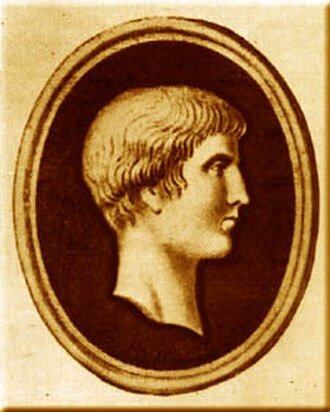
 AuthorMartial40–104
The Epigrams (Latin Epigrammata) are the principal work of the Latin poet Marcus Valerius Martialis (c. 40–104). The collection comprises fifteen books of short poems, often only two lines long and rarely more than twenty. The first, the Liber Spectaculorum, is in fact the author's earliest work, devoted to spectacles in the amphitheatre, and is usually treated apart from the rest. The remaining fourteen books form the core of the collection; the last two, Xenia and Apophoreta, group poems titled by their subject, as gifts or presents.
Most of the poems were composed between 85 and 98, in Rome or elsewhere in Italy, at roughly one book per year. Book XII was written in Hispania, at Bilbilis, around 101–102, after the poet's return to his home town, though it includes earlier pieces. Martial brought the epigram to its height; the genre had been practised in Greek by Meleager of Gadara and introduced into Latin literature by Catullus. His metrics are varied, dominated by the elegiac couplet, followed by the Phalaecian hendecasyllable and several forms of iambic trimeter. Five books are preceded by prose prefaces.
The themes often overlap with those of satire, but the treatment differs: the brevity demands concentrated wit, and moral purpose tends to recede. Rome, its inhabitants and the poet's own everyday experience stand at the centre of his inspiration. A significant number of epigrams also reflect on literature, on the epigrammatic genre, and on the author's relationship with his books and readers.
The work was read throughout late antiquity and the Middle Ages, and its epigrams exerted a strong influence across Europe between the fifteenth and eighteenth centuries, first imitated in Latin and then in the vernacular languages. Its reputation declined from the eighteenth century onward, partly because of its obscenity and partly because the epigram as a form fell out of favour.
Themes
Original Filopedia text based on Wikipedia (es) and Wikidata.