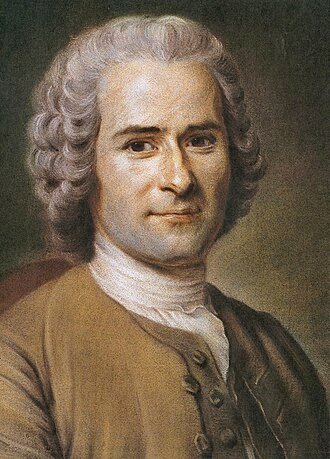
 AuthorJean-Jacques Rousseau1712–1778
Emile, or On Education is a treatise published in 1762 by Jean-Jacques Rousseau, who considered it the best and most important of all his works. It reflects on human nature and on how to raise a person who keeps his natural goodness while living in a corrupt society. To illustrate his ideas, Rousseau uses a novelistic narrative in which a young man, Emile, is educated by a tutor from childhood to maturity.
The book poses a central question. For Rousseau, man is good by nature, but society denatures him. For this reason he argues that every community must choose between forming a man or forming a citizen, and that education should try to reconcile the two. The work opens with its famous sentence, according to which everything is good when it leaves the hands of the Creator and everything degenerates in the hands of man, and it then develops an educational system that respects the stages of child development.
The book is divided into five parts. The first three deal with Emile's childhood, from infancy to early adolescence. In them Rousseau argues that a child is not a miniature adult and should learn mainly through direct experience, observation of the surrounding world, and a sense of what is useful. The fourth part addresses adolescence, the awakening of feelings and entry into social life, and includes the famous "Profession of Faith of the Savoyard Vicar", a defence of natural religion that proved especially controversial. The fifth part describes the education of Sophie, the woman destined to become Emile's wife, and offers a view of the differences between the sexes that is still widely debated today.
The book was condemned in France and Geneva, where copies were publicly burned, and Rousseau had to flee the country. Despite this, it became a major publishing success and had lasting influence. During the French Revolution it inspired ideas about national education, and it is considered one of the foundational texts of modern pedagogy, as well as a precursor of methods centred on the activity of the learner.
Themes
Other works by Jean-Jacques Rousseau
- Julie, or the New Heloise 1761
- The Social Contract 1762
- Confessions 1782
Original Filopedia text based on Wikipedia (es) and Wikipedia (en) and Wikidata.