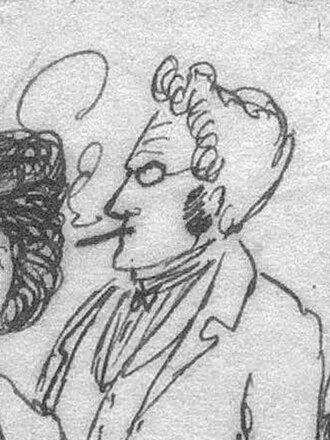
 AuthorMax Stirner1806–1856
The Ego and Its Own is a book by Max Stirner, the pen name of Johann Caspar Schmidt, published in early October 1844 in Leipzig by the publisher Otto Wigand. Shortly after its appearance it was censored, but the censorship was lifted soon afterwards, and the book could again be sold. The work belongs to the milieu of the Young Hegelians, a circle to which Stirner had belonged, and it offers a radical critique of the Prussian society of its time.
The book argues that the individual must be, before himself, the only supreme being. Stirner presents the ego as a subjective reality grounded in itself, which stands ultimately alone in the world, in contrast to much of the Western philosophical tradition that had placed truth or virtue in external authorities. For him, God, Humanity, Freedom or the Nation are abstract ideals, mental phantoms that subject the individual to a disguised servitude. Against them he defends a conscious egoism, not as a narrow pursuit of sensual pleasure, but as the full expression of one who openly accepts his own uniqueness. He distinguishes between «society», a forced and repressive association of alienated people controlled by the State, the Church or the educational system, and the «free association» of sovereign individuals who join together for shared interests.
The structure of the text follows a dialectical scheme modeled on the stages of life: childhood, subject to external forces; youth, dominated by inner ideas such as conscience and reason; and mature egoism, in which the individual recognizes himself as more than his mind or body. Stirner applies this pattern to human history and criticizes in particular the Protestant Reformation and the philosophy of Ludwig Feuerbach, whom he accuses of replacing God with a new deity, Humanity, with the same effects of subjection.
Its early reception was intense but largely hostile. Feuerbach, Moses Hess, Bruno Bauer and Kuno Fischer responded to it, and Marx and Engels criticized it harshly in The German Ideology, published in 1932. For decades it was little read, but its influence later grew within individualist anarchism, existentialism, nihilism and postmodernism.
Themes
Books to read
- The Ego and His Own EnglishGutenberg
Original Filopedia text based on Wikipedia (es) and Wikipedia (en) and Wikidata.