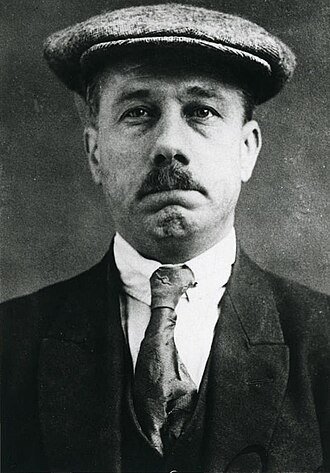
 AuthorB. Traven1882–1969
The Treasure of the Sierra Madre is an adventure novel originally written in German as Der Schatz der Sierra Madre and published in 1927 by the author known as B. Traven, whose real identity has never been firmly established. The book is set in the decade after the upheavals of the First World War and the social revolutions in Russia and Mexico. The United States is becoming an economic and political power, while European and American companies compete aggressively for foreign markets, natural resources and cheap labor. In Mexico, anticlerical governments push social reforms, including the eight-hour workday and programs to expand literacy and healthcare, while the Catholic Church struggles to protect its religious freedom.
The story opens in Tampico, a center of the oil boom, where Dobbs, an American with no steady job and no money, lives in a flophouse infested with vermin. After a brief spell working for an oil contractor, he meets Howard, an old and talkative gold prospector of great experience, who warns him about the perils of wealth: gold, he insists, distorts a man's judgment and never satisfies. Howard also tells the legend of the Green Water Mine, a cursed diggings which, according to tradition, was worked through the forced labor of indigenous people under Spanish rule, the complicity of the Church and a revolt that destroyed the mine and erased all trace of it. Dobbs, drawn in by the tale, joins forces with Howard and with Curtin, another American, and the three head into the mountains near Durango, where they find placer gold.
The novel combines an omniscient third-person voice with inserted stories that provide historical and social background. Howard is the focal character, and the book shows how, as the fortune grows, the partners change their class outlook: they move from working men to property owners, grow suspicious of the have-nots, and their alliance rests on profit rather than friendship. The arrival of Lacaud, a solitary prospector, and of a gang of bandits led by the so-called Gold Hat heightens the tension and brings the themes of greed and violence to a sharp climax.
The book is a meditation on the power of money and on how ambition corrodes human bonds, as well as a critical look at economic and colonial exploitation. It was well received in the German-speaking world and later in the English-speaking one, where Traven translated it himself in 1935. Its reputation grew enormously with John Huston's 1948 film, starring Humphrey Bogart, which won three Academy Awards and helped turn the novel into a classic of adventure fiction.
Themes
Other works by B. Traven
Original Filopedia text based on Wikipedia (es) and Wikipedia (en) and Wikidata.