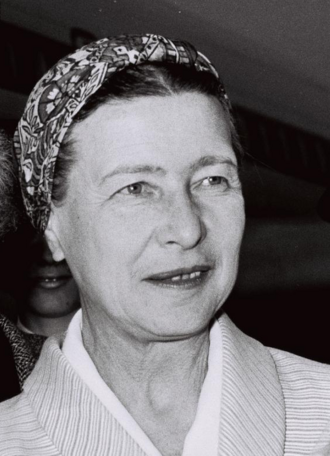
 AuthorSimone de Beauvoir1908–1986
The Second Sex is a lengthy essay published in 1949 by the French philosopher Simone de Beauvoir, a figure associated with existentialism. Beauvoir began writing it after reflecting on what being a woman had meant to her, and she researched and wrote it over roughly fourteen months between 1946 and 1949. The work appeared in two volumes, Facts and Myths and Lived Experience, and some of its chapters had first been published in the journal Les Temps modernes. It sold widely and provoked controversy: in 1956 the Catholic Church placed parts of the text on its Index of Forbidden Books.
Its central thesis is that "woman" as a social category, with traits such as coquettishness, tenderness or submissiveness, is a cultural construction imposed upon a sexed body. Beauvoir argues that women have always been defined in relation to something else, as mothers, wives, daughters or sisters, while men appear as the norm and the subject, and women as "the Other". Hence her famous line: "One is not born, but rather becomes, a woman." Biology plays a role, but it does not by itself explain the hierarchy between the sexes, which she traces to history, economics, education and institutions. The task of women, in her view, is to reclaim an identity of their own, defined by their own standards.
The book moves across many registers: biology, psychoanalysis, history, Marxism, anthropology and literature. The first volume examines the myths and the male gaze that have shaped views of women from antiquity to the twentieth century. The second describes lived experience: childhood, sexual initiation, marriage, motherhood and old age, showing how upbringing and social pressure lead women to accept their subordinate place.
The book is regarded as one of the founding works of feminism centred on equality and a basic reference of second-wave feminism. Its influence reaches later philosophy, sociology and literature, and it remains essential reading for anyone approaching debates about gender and personal freedom.
Themes
Other works by Simone de Beauvoir
Original Filopedia text based on Wikipedia (es) and Wikipedia (en) and Wikidata.