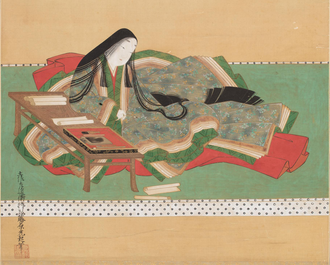
 AuthorMurasaki Shikibu970–1100
The Tale of Genji (Genji monogatari) is a novel written around the year 1000 by Murasaki Shikibu, a lady-in-waiting at the imperial court who served the Empress Akiko at the turn of the eleventh century. It is considered the masterpiece of Japanese Heian-period literature, and many regard it as the first novel in the modern sense. Its exact date of composition is unknown, but by 1021 the work was already complete in its present form, since the author noted in her diary the joy she felt at obtaining a full copy.
The novel follows Hikaru Genji, "Shining Genji", a son of the emperor and a low-ranking concubine. To avoid dynastic conflict, the emperor strips him of imperial status and makes him a commoner with the surname Minamoto, allowing him to pursue a career as a court official. His love affairs, political rise, exile at Suma and triumphant return form the first part, while the second shows his old age and death. The final section, known as the Uji chapters, follows his descendants Niou and Kaoru, whose rivalry over young women of Uji ends abruptly.
The work portrays court life in detail, with its rituals, rules of etiquette and the polygamy common at the time. Its characters are rarely given names; they are identified by office, rank or relationship to others, a convention reflecting court custom that requires readers to infer each person's social standing. The novel was also written in kana, the syllabary used by women, rather than in the Chinese characters reserved for men. It is further interspersed with poems that serve both expressive and narrative purposes, making it an excellent example of the poetry of its era.
The novel is noted for its minute psychological descriptions, the complexity of its characters, and its melancholy reflection on the fleeting nature of life, which pervades the text. Its authorship has been debated for centuries: Yosano Akiko, the first to translate it into modern Japanese, attributed the final chapters to Murasaki's daughter, Daini no Sanmi, a hypothesis scholars still discuss. Its influence on Japanese literature has been immense, and writers such as Jorge Luis Borges, Octavio Paz, Yasunari Kawabata and Marguerite Yourcenar acknowledged its importance.
Themes
Books to read
- The tale of Genji EnglishGutenberg
Other works by Murasaki Shikibu
Original Filopedia text based on Wikipedia (es) and Wikipedia (en) and Wikidata.