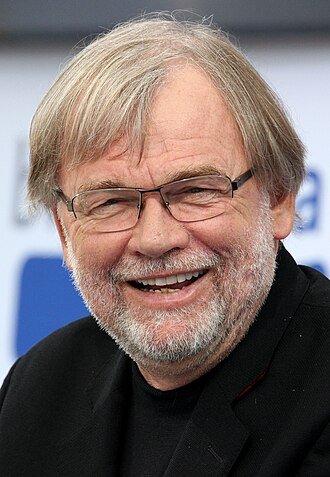
 AuthorJostein Gaarderb. 1952
Sophie's World is a novel published in 1991 by the Norwegian writer Jostein Gaarder. It became a bestseller in Norway and then in much of the world, and has been translated into dozens of languages. Its distinctive approach is to use a fictional plot as a vehicle for a basic overview of the history of Western philosophy.
The protagonist is Sophie Amundsen, a fourteen-year-old girl living in Lillesand, on the south coast of Norway. One day she finds in her mailbox a letter with two simple but unsettling questions: who are you, and where does this world come from? Soon afterwards a packet arrives containing the lessons of a correspondence course in philosophy, signed by a teacher called Alberto Knox. Sophie, without her mother knowing, becomes his pupil. The lessons trace thought from the pre-Socratics to Sartre, passing through Socrates, Plato, Aristotle, the Renaissance, the rationalism of Descartes and Spinoza, the empiricism of Locke, Hume and Berkeley, the Enlightenment, Kant, Romanticism, Hegel, Kierkegaard, Marx, Darwin and Freud.
In parallel, Sophie and Alberto receive postcards addressed to a girl named Hilde Møller Knag, sent by a man called Albert Knag. Over time Knag begins to conceal his birthday messages in increasingly impossible ways, and the reader gradually understands that the philosophical course and the postcards are connected. Through Berkeley's ideas, Sophie and Alberto discover that they are characters in a novel written by Knag as a gift for his daughter on her fifteenth birthday. Hilde begins reading the manuscript and turns against her father, who keeps interfering in Sophie's life by sending fictional figures such as Little Red Riding Hood or Ebenezer Scrooge.
The structure alternates narrative with long expository passages and, later, with monologues by Alberto, which gives the book a strongly didactic character. Its underlying thesis is that philosophy arises from the question of the origin and meaning of the world, and that each age has answered it differently. Through a metafictional game, the novel also suggests that the real world itself may be a fiction.
The book was a publishing phenomenon, selling millions of copies in many countries, and won the Deutscher Jugendliteraturpreis in 1994. Its success made it one of the most internationally successful Norwegian novels. It has been criticised for its occasionally schematic tone and its simplification of some doctrines, but it is widely valued as a gateway into philosophy for young and adult readers. It was adapted into a film in 1999 directed by Erik Gustavson, and has inspired television adaptations, a board game, a video game and a graphic novel.
Themes
Other works by Jostein Gaarder
Original Filopedia text based on Wikipedia (es) and Wikipedia (en) and Wikidata.