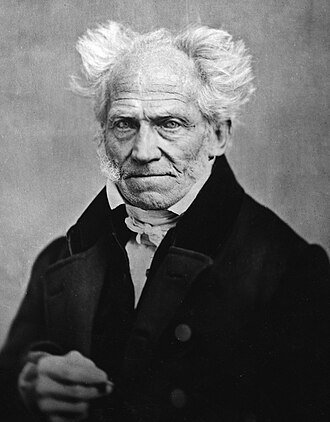
 AuthorArthur Schopenhauer1788–1860
The World as Will and Representation is the central work of the German philosopher Arthur Schopenhauer. It was first published in late 1818, though its title page bears the date 1819, by the Brockhaus publishing house in Leipzig. The first edition attracted almost no readers, and the publisher eventually sold much of the print run as waste paper. Schopenhauer revised and expanded the book in 1844 and again in 1859, the year before his death. Its reputation came late, after the appearance of Parerga and Paralipomena in 1851, and since then it has influenced thinkers and writers as different as Nietzsche, Freud, Cioran and Borges.
The work takes the transcendental idealism of Kant as its starting point, but it also draws on Plato, Hume and Berkeley, as well as on the Indian Upanishads and Buddhist thought. Its aim is to explain the world in all its aspects through two central concepts: representation and will. Schopenhauer argues that no one can step outside themselves to know things directly; what we know is the world as it appears to our minds, shaped by the forms of space, time and causality. This phenomenal world is, for him, a kind of appearance. The ultimate reality, Kant's thing-in-itself, is a blind will, without aim or knowledge, which manifests itself in everything from natural forces to human impulses.
From this view follows a radical pessimism. Human beings, slaves to a desire that is never fully satisfied, suffer inevitably, and Schopenhauer rejects Leibniz's claim that we live in the best of all possible worlds. Against this suffering he proposes two paths of release: aesthetic contemplation, which suspends for a moment the domination of the will, and the ascetic denial of the will to live, which he associates with the saintliness of certain mystics, Buddhists and Hindus. The book is organized into four parts, covering the theory of knowledge, the ontology of the will, aesthetics and ethics, and it closes with a critical appendix on Kant's philosophy.
Themes
Other works by Arthur Schopenhauer
Original Filopedia text based on Wikipedia (es) and Wikipedia (en) and Wikidata.