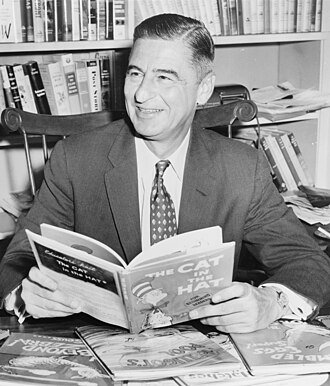
 AuthorDr. Seuss1904–1991
The Lorax is a children's book written and illustrated by Dr. Seuss and published in 1971. The author counted it among his personal favourites. He said it grew out of anger at the ecology books he had read, which struck him as dull, and he wanted to write something that attacked what he considered evil and let the consequences fall where they might.
The story opens when a young boy, living in a gloomy town on the edge of a grey woodland, wanders to the Street of the Lifted Lorax and meets a mysterious figure known as the Once-ler. The boy pays him fifteen cents, a nail and the shell of a great-great-great-grandfather snail to hear how the valley came to ruin. The Once-ler recalls that, long ago, he arrived in a beautiful valley full of Truffula trees and playful animals. Seeking material for the Thneed, a highly versatile garment that everybody, he insists, needs, he chopped down a tree. A small, stern creature called the Lorax then rose from the stump, speaking for the trees, which have no tongues, and warning of what would follow. The Once-ler ignored him, summoned his relatives to help run a factory, and production grew unchecked. Pollution spread, the animals fled, and at last the final Truffula fell. The factory closed, the family left, and the Lorax drifted away into the clouds, leaving a stone bearing a single word: UNLESS.
Today the book is widely read as a fable about corporate greed and its toll on nature. Seuss gives human form to industry, the environment and activism, and its ending calls on the reader to act, since, in the Once-ler's closing words, nothing will get better unless someone cares a whole awful lot. In 2007 it was listed among the best children's books in an online poll by the National Education Association, and in 2012 it ranked high in a School Library Journal survey of picture books. Critics have been divided: in 2011 the journal Nature called the Lorax a parody of a misanthropic ecologist and found the book gloomy, though it praised its power to show young readers the consequences of ecological destruction.
The book has also provoked controversy. In 1988 a Californian school district kept it on a reading list for second-graders despite complaints that it was unfair to the logging industry. Later, a flooring trade association published Truax, a booklet by Terri Birkett that parodied the story from a pro-logging standpoint. A line about Lake Erie was dropped from the printed text after objections from two researchers in Ohio, although it remains in the television special.
The story has been adapted many times: as an animated musical television special in 1972, with the voices of Eddie Albert and Bob Holt; as a computer-animated feature film in 2012, with Danny DeVito as the Lorax and Zac Efron as the boy; and in several stage productions, including one at the Old Vic in London in 2015.
Themes
Other works by Dr. Seuss
Original Filopedia text based on Wikipedia (es) and Wikipedia (en) and Wikidata.