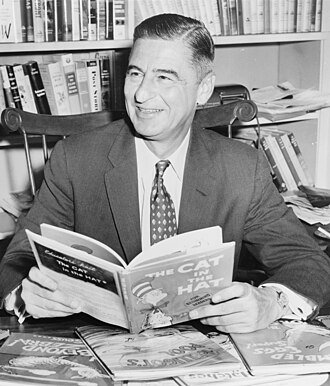
Dr. Seuss
1904–1991 · American children's author, illustrator and cartoonist
Theodor Seuss Geisel, known as Dr. Seuss, was an American writer, illustrator and cartoonist born in 1904 in Springfield, Massachusetts, and who died in 1991 in California. He wrote and illustrated more than sixty children's books, many of them among the best-selling books of all time. His importance lies in showing that children could learn to read through rhyme, imaginative drawings and simple vocabulary.
Born into a family of German descent, he grew up in Springfield, where his father ran the city's parks. At Dartmouth College he lost his position on the campus humor magazine after an alcohol-related violation during Prohibition, so he began signing his pieces as Seuss. He then went to Oxford, where he met Helen Palmer, whom he married in 1927. Without a degree, he returned to the United States and built a career as a cartoonist for Judge, Life and Vanity Fair. His advertising campaign for the Flit bug spray, with the line "Quick, Henry, the Flit!", brought him national fame.
During the Second World War he drew political cartoons against Hitler and Mussolini for the New York paper PM. He then joined the Army, where he led the animation unit of an Air Forces film department. His first children's book, inspired by the rhythm of a ship's engines, appeared in 1937 after, by his own accounts, numerous publishers had turned it down.
After the war he returned to children's books with bouncy rhymes and pen-and-ink drawings, often in black and white. The Cat in the Hat grew out of an editorial challenge: write an appealing book using a very small vocabulary for children just learning to read. His stories, such as The Lorax, about environmental damage, or Horton Hears a Who!, about identity and respect for the small, address serious themes with humor and fantasy. His wordplay and tongue-twisting meter are hard to carry into other languages without losing their charm.
His legacy lies in the teaching of reading, in the generations of readers his books have shaped, and in the Dr. Seuss National Memorial Sculpture Garden, opened in Springfield in 2002. In 1984 he received a Pulitzer Prize Special Citation for his contribution to children's literature.
Key works
- And to Think That I Saw It on Mulberry Street (1937): his first children's book, a poem built around an imagined walk down a street in his hometown.
- The Cat in the Hat (1957): a classic written with a restricted vocabulary that turned early reading into play.
- How the Grinch Stole Christmas! (1957): the story of a grumpy character who tries to spoil a town's Christmas.
- The Lorax (1971): an environmental fable about the reckless exploitation of forests.
Where to start
The Cat in the Hat 1957
The Cat in the Hat is an illustrated children's book in rhyming verse about a mischievous, towering cat in a stovepipe hat who bursts into a bored household on a rainy day. It is accessible and light, and it shows the humor, rhythm and inventiveness that define the author.
Next: How the Grinch Stole Christmas!. How the Grinch Stole Christmas! is another hugely popular rhyming tale, and its green villain leads into a story about generosity.
Works in Filopedia
Curiosities
A catchphrase that reached the street
The line "Quick, Henry, the Flit!" became so popular that it inspired a song and was used as a punchline by radio comedians.
A bet with an uncertain ending
According to a story often repeated, Bennett Cerf bet him $50 that he could not write a book using only fifty words. The result would be Green Eggs and Ham, though it has never been confirmed that Cerf paid up.
A vocabulary challenge
His publisher asked him to cut a list of 400 words down to 250. Using 220 of them, Seuss finished The Cat in the Hat about nine months later.
Original Filopedia text based on Wikipedia (es) and Wikipedia (en) and Wikidata.