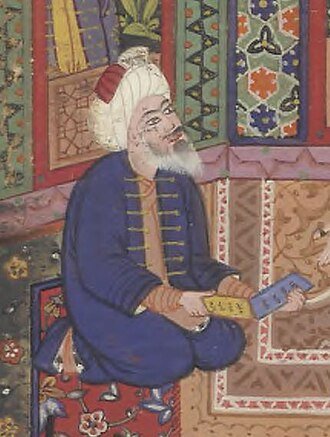
 AuthorSanai1080–1131
The Walled Garden of Truth (Persian: Hadiqat al-Haqiqa va shariat al-tariqa) is the best-known work of the Persian poet and mystic Sanai of Ghazna, who lived roughly between 1080 and 1131. It is written as a mathnawi, the rhyming-couplet form characteristic of Persian literature, with a scheme of aa/bb/cc. According to the sources, Sanai composed it after a long search for spiritual perfection and following a pilgrimage to Mecca and Medina, and dedicated it to the Ghaznavid sultan Bahram Shah, who reigned c. 1117–1157. In its longest form it has about ten thousand verses divided into ten books.
According to John Stephenson's account, the books deal with praise of God and his unity, with the Prophet Muhammad, with understanding and knowledge, with love between lover and beloved, with spiritual negligence, with friends and enemies, with the revolution of the heavens, with praise of the ruler, and finally with the work as a whole. The first book, which covers many different subjects, focuses mainly on the experience of the Sufi seeker: renunciation of the self (fana) and of the world, humility, the insignificance of the human being before divine omnipotence, and the need to remember God constantly. The order of the books varies between manuscripts, which makes it hard to establish a definitive text. The earliest surviving witnesses include a copy made in Konya in 1157, which contains a short version titled Fakri-nama, and another from 1192 called Ilahi-nama, the title by which Rumi refers to it.
The tone is biting and incisive. Sanai does not aim at gratuitous attack; he seeks to wake the reader from the sleep of forgetfulness (ghaflat) and from complacency. For this reason he is regarded as a parenetic or homiletic poet, whose purpose is to encourage the search for life's deeper meaning beyond fleeting worldly superficialities.
The work had lasting influence. Nizami Ganjavi acknowledged his debt to it in the Makhzan al-Asrar, Attar and Rumi praised it, and later Persian mystical poets took it as a poetic and spiritual guide. After the critical edition by Abd al-Latif Abbasi in the seventeenth century, the text became clearer and more widely circulated. The first English translation, by John Stephenson in 1910, concentrated on the first book, and in 1974 D. L. Pendlebury published an abridged version, The Walled Garden of Truth, which made the work known to a wider public.
Themes
Original Filopedia text based on Wikipedia (es) and Wikipedia (en) and Wikidata.