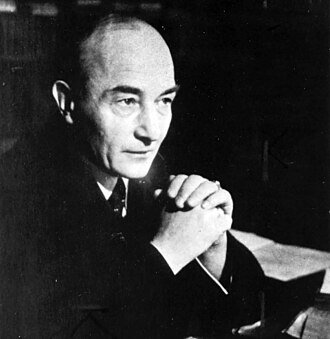
 AuthorRobert Musil1880–1942
The Man Without Qualities (Der Mann ohne Eigenschaften) is a novel by the Austrian writer Robert Musil (1880-1942), on which he worked from 1921 until his death in 1942, and which he never finished. The first volume appeared in Berlin in 1930, the second part in 1933; the remaining material, gathered by his widow Martha, was published posthumously in 1943. It is therefore a work that took shape over more than two decades and never reached the final form its author intended.
The story is set in Vienna in 1913, in the last years of the Austro-Hungarian Empire, which Musil nicknames "Kakania", a playful reference to the abbreviation K und K (imperial and royal). Its protagonist, Ulrich, is a mathematician in his early thirties who, instead of committing to a vocation or a firm conviction, describes himself as a man without qualities: someone who observes life with an analytical passivity and an ambiguous indifference toward morality and toward his own traits.
The central thread is the so-called "Parallel Campaign", an official initiative meant to celebrate the seventieth anniversary of Franz Joseph I's reign and to rival the thirty years of Wilhelm II in Germany. No one manages to define what it should actually be, and its committee loses itself in grand but vague discussions. Around it move figures such as Diotima, Ulrich's cousin and host of a philosophical salon, the Prussian millionaire Arnheim, General Stumm von Bordwehr and Count Leinsdorf, who embody intellectual vanity, economic pragmatism, militarism and aristocratic indecision. The novel also introduces Moosbrugger, a condemned murderer, and Clarisse, the wife of one of Ulrich's friends, whose refusal to accept conventional life leads her toward madness.
The third part, "Into the Millennium", focuses on Ulrich's relationship with his sister Agathe, a bond of almost mystical intensity in which they see themselves as soulmates. The book ends with a mass of drafts, notes and unfinished passages, showing Musil still searching for an ending he never settled on.
The work is in large part an ironic portrait of pre-war Viennese society, whose central paradox Musil sums up as a liberal constitution with a clerical government. Yet its reach goes far beyond historical testimony. It is a novel of ideas that discusses power, music, crime, love and the relation between thought and action, and that reflects on the crisis of rationalism and the search for a feeling capable of giving meaning to a life suffocated by science. His notion of the "hovering life", a synthesis of scientific fact and the mystical, makes it a central text of interwar European fiction.
Its length and fragmentary character have kept it less widely read than its influence would suggest, but it is now counted among the great novels of the twentieth century and has been compared with Hermann Broch's The Sleepwalkers and Stefan Zweig's The World of Yesterday.
Themes
Other works by Robert Musil
Original Filopedia text based on Wikipedia (es) and Wikipedia (en) and Wikidata.