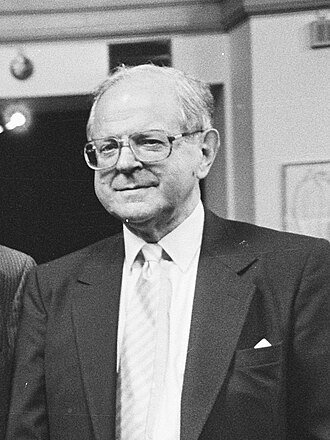
 AuthorRobert Conquest1917–2015
The Great Terror is a 1968 book by the British historian Robert Conquest that examines the so-called Great Purge, the campaign of repression unleashed by Stalin chiefly between 1936 and 1938. It was one of the first books by a Western author to treat the episode as a whole. Conquest drew on information made public during the Khrushchev Thaw (1956–1964), on accounts by Russian and Ukrainian émigrés and exiles dating back to the 1930s, and on official Soviet documents, including the 1937 census, whose figures he regarded as unreliable.
Before this work, attention had centred on the Moscow Trials, in which disgraced Communist leaders such as Nikolai Bukharin and Grigory Zinoviev confessed to crimes they had not committed. Conquest argued that these trials and the executions that followed were only a minor part of a much wider terror that included deportations, mass executions and deliberately engineered famines, such as the one in Ukraine. His original edition estimated some 20 million deaths; the preface to the fortieth-anniversary edition lowered the figure to between 13 and 15 million. A 1990 revised edition, titled The Great Terror: A Reassessment, incorporated material from Soviet archives opened under glasnost.
One of the book's most contested claims is that Stalinism was not a betrayal of the revolution's ideals, as Khrushchev maintained, but a consequence of the political system Lenin had established, although Conquest acknowledged that Stalin's personality shaped the particular atrocities of the late 1930s. He also criticised Western intellectuals of the left, among them Sidney and Beatrice Webb, George Bernard Shaw, Jean-Paul Sartre and Walter Duranty, for denying or excusing the repression.
The book was widely read by the general public and by Soviet dissidents, but it provoked a lasting scholarly debate. Historians such as J. Arch Getty, Stephen Wheatcroft and Michael Ellman have criticised its reliance on hearsay and its figures, which they consider too high, while others, such as Stéphane Courtois and Robert Gellately, have kept estimates of similar magnitude. Eric Hobsbawm praised it as a pioneering effort, though he judged it superseded once the archives became accessible.
Themes
Original Filopedia text based on Wikipedia (es) and Wikipedia (en) and Wikidata.