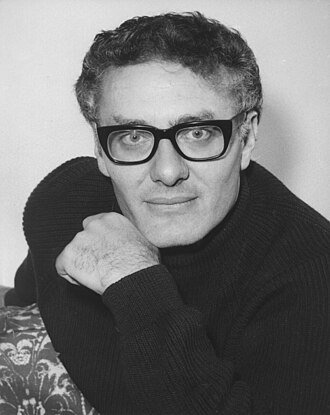
 AuthorPeter Shaffer1926–2016
Black Comedy is a one-act comedy by Peter Shaffer, first performed in 1965. Its defining feature is a theatrical conceit: the play is staged under a reversed lighting scheme. It opens on a darkened stage; after a short circuit, the lights come up to reveal the characters in a blackout. The characters behave as though no one can see them, while the audience sees everything clearly. The premise grew out of a specific commission. In the early spring of 1965, Kenneth Tynan, dramaturge of the National Theatre, asked Shaffer for a short play to accompany a production of Miss Julie starring Maggie Smith and Albert Finney. Shaffer wanted a more sustaining dramatic idea than the mere gimmick of inverse lighting, and he settled on the notion that one character has a reason to keep the others in the dark, so that the blackout becomes the ideal setting for a farce built on lies.
The story centres on Brindsley Miller, a young sculptor, and his fiancée Carol Melkett. To impress Carol's father, Colonel Melkett, and a wealthy prospective art buyer, Georg Bamberger, they have borrowed expensive antique furniture from their neighbour Harold Gorringe without his permission while he is away for the weekend. When the power fails, a series of unexpected arrivals follows: Harold returns early, Clea, Brindsley's former mistress, appears, and the elderly spinster Miss Furnival comes down seeking refuge from her fear of the dark. Brindsley tries, silently and by touch, to return the furniture to its place while piling one lie on another to cover his situation. Confusion mounts when Miss Furnival, a lifelong teetotaller, accidentally drinks and becomes unrestrained, and when a German electrician, Schuppanzigh, is mistaken for Bamberger and, by torchlight, admires Brindsley's sculpture.
The play premiered at the Chichester Festival Theatre in July 1965, directed by John Dexter, and then moved to the Old Vic in London, with Derek Jacobi as Brindsley and Maggie Smith as Clea. Critics received it well overall, though several felt it dragged a little toward the end. The Broadway production in 1967 was warmly welcomed. Over time it has become one of the most frequently performed British farces of the twentieth century and has been adapted and staged around the world. It is often paired with The White Liars, another short Shaffer piece, forming a double bill.
The work draws on the rhythm of classic farce, with its doors, misunderstandings and characters concealing their actions, but its originality lies in making lighting part of the comic mechanism: what the audience sees and what the characters believe they see never coincide, and much of the humour comes from that gap. Beneath the farce, themes of deception, artistic vanity and hidden desire also emerge.
Themes
Original Filopedia text based on Wikipedia (es) and Wikipedia (en) and Wikidata.