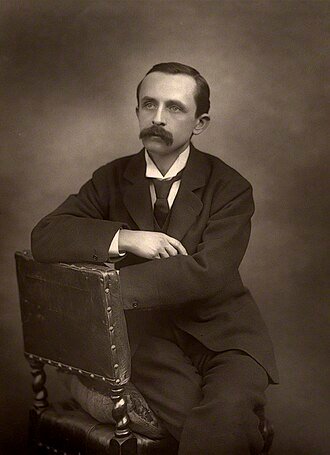
 AuthorJ. M. Barrie1860–1937
The Admirable Crichton is a comic play written by the Scottish dramatist J. M. Barrie and first staged in London in 1902, shortly after he had established himself as a successful author in the West End. Its title comes from an epithet that Sir Thomas Urquhart applied to the sixteenth-century Scottish traveller, polymath and swordsman James Crichton. Barrie's protagonist, a resourceful and practical butler, shares with that historical figure the capacity to excel in any circumstance.
The play gently satirises the British aristocracy. In the first act, Lord Loam, a peer, believes that class divisions are artificial and hosts gatherings at which his servants mingle with his guests, to the discomfort of everyone. Only his butler, Crichton, disapproves of the experiment, convinced that the class system is the natural outcome of a civilised society. When Loam, his family and friends are shipwrecked on a deserted tropical island, the social order is turned upside down. Crichton is the only one with enough practical knowledge to survive, and he gradually takes the lead, at first reluctantly. Two years later he has organised farming and communal life, has grown accustomed to the privileges of power, and Lady Mary, Loam's daughter, has fallen in love with him. Rescue returns everyone to their former lives, and the final act, back at the country house, shows the former masters uneasy in the presence of their butler and whispering about what happened on the island.
The play was generally well received by critics on both sides of the Atlantic, who praised its originality and lightness. Barrie, however, was careful about its ending: it is said that he set aside a bolder conclusion in which Crichton and Lady Mary would continue their relationship, judging that audiences in the stalls would not accept it. Productions have followed one another in many countries since, and the story has been adapted for the screen several times, including Cecil B. DeMille's Male and Female (1919) and the British film of 1957 starring Kenneth More.
Themes
Books to read
- The Admirable Crichton EnglishEPUB 130 KBRead online
Other works by J. M. Barrie
- The Little White Bird 1902
- Peter Pan 1911
Original Filopedia text based on Wikipedia (es) and Wikipedia (en) and Wikidata.