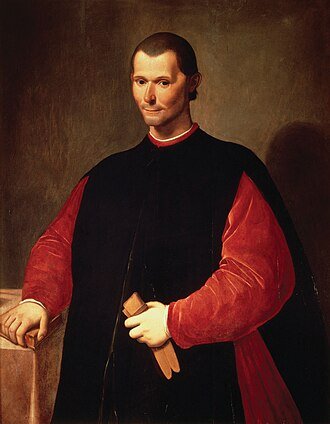
 AuthorNiccolò Machiavelli1469–1527
The Discourses on Livy is a work by Niccolò Machiavelli, written in Italian, in which the Florentine thinker reflects on republican government through a commentary on the history of Rome by the Latin historian Livy. Machiavelli began writing it in 1512, during his enforced retirement at Sant'Andrea in Percussina, and set it aside the same year to write The Prince. He resumed and completed the work around 1517, but it was not published until 1531, after his death, with papal privilege.
The title refers to the first ten books of Livy's history, which relate Rome's expansion up to the end of the Third Samnite War, although Machiavelli draws examples from many other periods, including the politics of his own time. His aim is to extract useful lessons from the past for the present and to explain the structure and advantages of the republic, a form of government founded on consensus and popular control. Unlike The Prince, which is brief and focused on individual power, the Discourses are an extensive and orderly commentary, and in them Machiavelli holds that history moves in cycles and that the virtue of the ancients can serve as a model.
The work consists of a dedicatory letter to Zanobi Buondelmonti and Cosimo Rucellai, members of the Florentine circle of the Orti Oricellari, and three books. The first, the longest, deals with the internal organisation of the republic, its laws, and the role of religion as a political instrument. The second addresses war and external expansion, and the third, closer in spirit to The Prince, examines the actions of individuals who found, reform or corrupt states, as well as conspiracies.
Along the way, Machiavelli also criticises the Italy of his day, divided and lacking political unity, and blames the Church for much of that weakness, arguing that it prevented the country from uniting under a single ruler. He judges Roman religion by its civic usefulness rather than by the truth or falsehood of its beliefs.
The reception of the Discourses was intense and contradictory. They influenced later republican thinkers, from seventeenth-century England to the modern republican tradition, and they also drew condemnation for their view of power and religion. Today they are regarded as one of the foundational works of modern political thought.
Themes
Other works by Niccolò Machiavelli
- The Prince 1532
Original Filopedia text based on Wikipedia (es) and Wikipedia (en) and Wikidata.