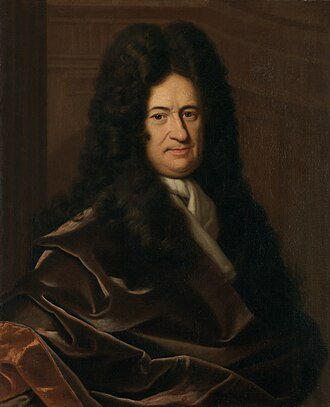
 AuthorGottfried Wilhelm Leibniz1646–1716
The Discourse on Metaphysics is a short treatise that Gottfried Wilhelm Leibniz wrote in 1686, in which he sets out his early philosophy: a conception of physical substance, of motion and the resistance of bodies, and of God's role in the universe. It is one of the few texts in which this early philosophy appears in a consistent form.
The work is closely tied to the correspondence Leibniz maintained with Antoine Arnauld. Leibniz, however, refrained from sending him the complete text, and it remained unpublished until the mid-nineteenth century. Arnauld received only an abridged version in 37 points, which reproduced whole paragraphs and guided the exchange between the two men.
The argument moves from God toward the substantial world and back to the spiritual realm. It starts from the idea of God as an absolutely perfect being and holds that goodness does not depend on an arbitrary divine will, rejecting theological voluntarism. God, having created an orderly and perfect world, chose the best of all possible worlds: taking every fact into account, no better world could be imagined. Evil, far from impugning divine omnipotence, is for Leibniz a confirmation of it.
A striking feature of the text is its attitude toward scholastic philosophy. At a time when modern philosophy had largely been built against medieval precepts, Leibniz claims that the opinions of the scholastic philosophers should not be wholly dismissed. He attributes their failures to a lack of rigour rather than to deep errors, and suggests that a careful mind clarifying its thoughts in the manner of analytic geometers would find a great treasure of demonstrable truths.
The Discourse is also a key document for understanding his notion of individual substance, according to which each substance expresses the whole universe in its own way, and for his treatment of freedom, contingency and divine grace. Many of these ideas were later developed in the Monadology and in the Principles of Nature and Grace.
Themes
Other works by Gottfried Wilhelm Leibniz
- Theodicy 1710
- Monadology 1720
- New Essays on Human Understanding 1765
Original Filopedia text based on Wikipedia (es) and Wikipedia (en) and Wikidata.