Cyropaedia
partly fictional biographical work and treatise on political education
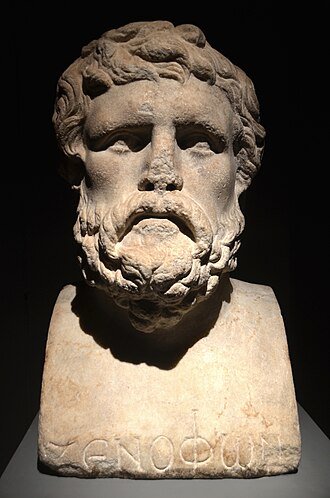 AuthorXenophon430 BC–353 BC
The Cyropaedia, whose title means "The Education of Cyrus", is a work by Xenophon, probably written between 380 and 365 BC. It recounts the youth, rise and reign of Cyrus the Great, founder of the Achaemenid Persian Empire, but it is not meant as a rigorous historical chronicle. Its aim is to present the ideal of the good ruler and the gentleman through the figure of Cyrus, so that history serves as a vehicle for moral and political instruction. For this reason the work resists easy classification: it has been read as an early novel, as a biography, and as a manifesto on leadership.
The work is divided into eight books. The first covers Cyrus's education among the Persians, his stay at the court of his maternal grandfather, Astyages, king of the Medes, and his training as a prince under his father, Cambyses. Books II and III describe the military preparations and the campaigns against Armenia and Chaldea, which Cyrus wins through discipline, incentives and good equipment for his troops. Books IV to VII narrate the war against Assyria, the march towards Babylon and the capture of that city. Book VIII turns to the organisation of the court and the empire, to Cyrus's relations with his friends, and to his old age, when he gathers his sons and gives them his final counsel about the danger of division.
Xenophon knew Persia at first hand, having served as a Greek mercenary in the expedition of the Ten Thousand in the service of Cyrus the Younger, recounted in the Anabasis. That experience gave him knowledge of Persian oral traditions, yet the work contains many historical inaccuracies and possible anachronisms, which is why its value as a source for Achaemenid history has been widely debated.
The final epilogue, which laments the moral decline of Persia in the author's own time, is the most disputed passage. Some scholars accept it as authentic, while others regard it as spurious. The Cyropaedia had a considerable later influence: it was read as a model for princely education and ideal government in antiquity and the Renaissance, and its portrait of Cyrus inspired thinkers of many periods.
Themes
Books to read
- Cyropaedia: The Education of Cyrus EnglishEPUB 326 KBRead online
Other works by Xenophon
Original Filopedia text based on Wikipedia (es) and Wikipedia (en) and Wikidata.