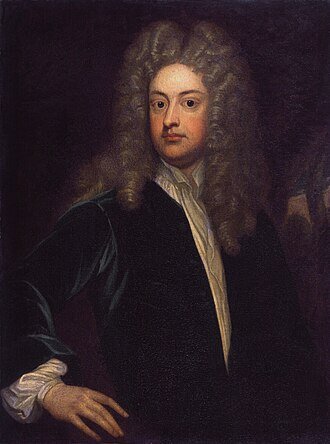
 AuthorJoseph Addison1672–1719
Cato, a Tragedy is a verse drama in blank verse by Joseph Addison, written in 1712 and first performed on 14 April 1713 at the Theatre Royal, Drury Lane, in London. Its protagonist is Marcus Porcius Cato Uticensis, better known as Cato the Younger (95–46 BC), a Stoic whose resistance to Julius Caesar's tyranny made him an emblem of republicanism, virtue and liberty. The play dramatises the last days of Cato, who has taken refuge in Utica, in present-day Tunisia, with the remnants of the Roman Senate after the civil war against Caesar.
The plot follows the intrigues at Cato's court. The senator Sempronius, resentful because Cato refuses to let him marry his daughter Marcia, plans to betray him; Syphax, adviser to the Numidian prince Juba, tries to turn Juba against Cato, but Juba stays loyal out of devotion to Cato and love for Marcia; and Cato's sons, Marcus and Portius, face their own romantic dilemmas. Addison sets individual liberty against tyranny, republic against monarchy, reason against emotion, and Cato's steadfastness in the face of death. The work has a prologue by Alexander Pope and an epilogue by Samuel Garth.
It was a success throughout England, its colonies and Ireland. In 1749 Frederick, Prince of Wales, staged it at Leicester House as a political gesture against his father, George II, with a specially written prologue stressing that the family's children had been born and raised in England. In the American colonies the play remained popular for several generations and is widely regarded as a probable literary inspiration for the American Revolution, since many of the Founding Fathers knew it well. George Washington is said to have attended a performance with his officers at Valley Forge in 1778, and it has been suggested that the play inspired Nathan Hale's famous line, "I only regret that I have but one life to lose for my country."
Themes
Original Filopedia text based on Wikipedia (en) and Wikidata.