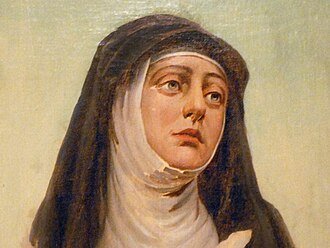
 AuthorHéloïse d’Argenteuil1101–1164
The Letters of Abelard and Heloise are two series of passionate and intellectual correspondence, apparently written in Latin in the twelfth century and attributed to Peter Abelard, a prominent theologian, and to his former pupil Heloise, a gifted young woman who later became an abbess. After a doomed love affair and their subsequent monastic lives, the two exchanged letters that reveal both their personal bond and their intellectual partnership, while offering an intimate view of the social world of twelfth-century Europe.
The first series, the best known, comprises fifteen letters: nine attributed to Abelard, four of them addressed to Heloise, the first being the Historia Calamitatum, and six attributed to Heloise, three addressed to Abelard and one to Peter the Venerable. Four further letters between Peter the Venerable and Heloise are usually associated with this set. Jean de Meun translated the Latin letters into French in the 1280s, and the earliest surviving manuscripts date from the late thirteenth century; it is thought that Heloise kept the letters at the Paraclete, the community she led. The first Latin printed edition appeared in Paris in 1616, and numerous European translations followed. In the eighteenth century the couple were revered as tragic lovers united in death, and their remains were given a place of honour in the Père Lachaise cemetery in Paris. Twentieth-century scholars long debated their authenticity, but by the early twenty-first century most accepted them as the work of the two writers.
The second series consists of 113 anonymous letters, the Epistolae Duorum Amantium, transcribed in the late fifteenth century by the monk Johannes de Vepria. They describe a relationship between a male teacher and a female student that went beyond the academic, and most letters are marked with the initials V and M (Vir and Mulier), which have been linked to the couple of the first series. Since 1974 some scholars have argued that Abelard and Heloise wrote them during their early romance, while others regard them as a model collection or even a parody; their authorship remains disputed.
Taken together, these letters are key documents on love, gender roles and monastic life in the Middle Ages, and they hold a significant place in the development of Western epistolary literature.
Themes
Books to read
- Letters of Abelard and Heloise To which is prefix'd a particular account of their lives, amours, and misfortunes EnglishEPUB 186 KBRead online
Original Filopedia text based on Wikipedia (en) and Wikidata.