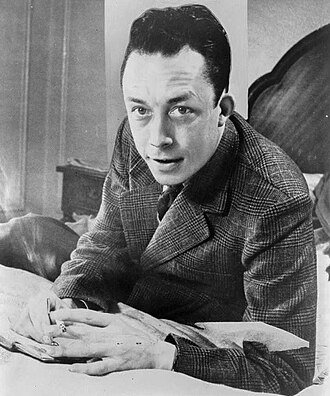
 AuthorAlbert Camus1913–1960
Caligula is a four-act play by the French writer and philosopher Albert Camus, published for the first time in May 1944 by Éditions Gallimard. Camus began it in 1938, and the final version premiered on 26 September 1945 at the Théâtre Hébertot in Paris, with Gérard Philipe in the title role and direction by Paul Œttly. It belongs to what Camus called the "Cycle of the Absurd", alongside the novel The Stranger and the essay The Myth of Sisyphus. Many critics have described it as existentialist, a label Camus always rejected.
The play portrays the Roman emperor Caligula, shattered by the death of Drusilla, his sister and lover. In Camus's own account, the prince, until then a relatively kind man, realises that men die and are not happy. From then on he becomes obsessed with the Absolute and tries to exercise a freedom through murder and the systematic overturning of all values, only to discover that it is not true freedom. He rejects friendship, love, simple human solidarity and the distinction between good and evil, and drags those around him into the logic of his refusal. His error is to deny other people: one cannot destroy everything without destroying oneself. Consistent with his logic, Caligula arms those who will eventually kill him. Camus presented the work as the story of a superior suicide and of the most human and most tragic of errors.
There are two versions: a three-act text written in 1941 and not published until 1984, and the four-act version of 1944. The differences between them reflect the effect of the Second World War on the author. The play has been staged many times in Spain, from the Mérida Classical Theatre Festival in 1963 to the María Guerrero Theatre in 2018.
Themes
Other works by Albert Camus
- The Stranger 1942
- The Myth of Sisyphus 1942
- Neither Victims nor Executioners 1946
- The Plague 1947
- The Rebel 1951
- The Fall 1956
- A Happy Death 1971
Original Filopedia text based on Wikipedia (es) and Wikipedia (en) and Wikidata.