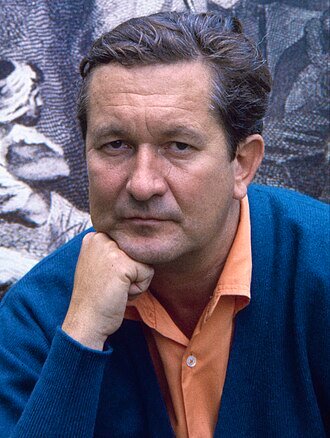
William Clark Styron Jr. (Newport News, Virginia, 1925 – Martha's Vineyard, Massachusetts, 2006) was an American novelist and essayist who won major literary prizes, including the Pulitzer Prize for Fiction in 1968. Writing in English, he belongs to the postwar American tradition that returned again and again to the South, slavery and the Holocaust.
He was born in Hilton Village, close to the area where Nat Turner led a slave rebellion in 1831, an event that later became the basis of one of his most controversial novels. His northern mother and his Southern, liberal-minded father gave him an unusually open view of race for his generation. His childhood was hard: his father suffered from depression, and his mother died of breast cancer when he was fourteen. He attended Christchurch School in Virginia, then Davidson College and Duke University. During the Second World War he joined the Navy, but never saw combat, as Japan surrendered shortly after his ship left San Francisco.
After graduating from Duke in 1947, he worked briefly as an editor in New York, a job he later described with irony. His first novel, Lie Down in Darkness (1951), brought him early recognition and the Rome Prize. He then spent a long period in Europe, where he befriended writers such as Romain Gary, James Baldwin and George Plimpton, and with them helped found The Paris Review in 1953. Set This House on Fire (1960), set on the Amalfi coast, received mixed reviews.
The book that generated the most debate was The Confessions of Nat Turner (1967), a fictional memoir of the rebellion's leader. Several Black critics condemned his portrayal as racist stereotyping, especially a passage in which Turner fantasizes about a white woman, while others defended the novel. It nevertheless sold well and won the Pulitzer. Sophie's Choice (1979), about a Polish survivor of Auschwitz, was also an international bestseller and won the National Book Award in 1980; Alan J. Pakula's film adaptation received five Academy Award nominations.
His last major work was the memoir Darkness Visible (1990), in which he described a severe depressive episode he had suffered in 1986 and sought to challenge the stigma surrounding mental illness. Styron's legacy lies in a body of work that blends historical fiction, essay and personal reflection, and in the debates it sparked about how slavery and the Holocaust should be represented, as well as in his public advocacy on depression.
Key works
- Lie Down in Darkness (1951): his first novel, about a troubled Virginia family, which brought him early fame.
- The Confessions of Nat Turner (1967): a fictional memoir of the leader of the 1831 slave rebellion, winner of the Pulitzer Prize.
- Sophie's Choice (1979): the story of a Polish survivor of Auschwitz, told by a young Southerner living in Brooklyn.
- Darkness Visible (1990): a memoir of his severe depression.
Works in Filopedia
- Darkness Visible 1990
Curiosities
A clash with censorship
*Sophie's Choice* was banned in South Africa and censored in the Soviet Union, according to records of the novel's reception.
Baldwin's prediction
James Baldwin, who stayed in Styron's home while he was writing the Nat Turner novel, predicted that Styron would be attacked from both sides. His prediction proved correct.
Teachers and influences
Influenced by
- Mark Twain 1835–1910
- James Joyce 1882–1941
- Albert Camus 1913–1960
- Gustave Flaubert 1821–1880
- William Faulkner 1897–1962
- F. Scott Fitzgerald 1896–1940
- John Dos Passos 1896–1970
- Thomas Wolfe 1900–1938
Influenced
- Janet Frame 1924–2004
Original Filopedia text based on Wikipedia (es) and Wikipedia (en) and Wikidata.