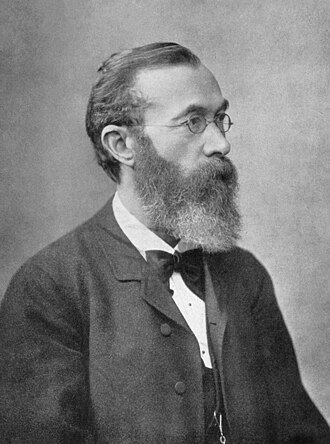
Wilhelm Wundt
1832–1920 · German physiologist, physician and philosopher, a father of experimental psychology
Childhood and early upbringing
Wilhelm Maximilian Wundt was born on 16 August 1832 in Neckarau, near Mannheim, in the German principality of Baden. His father was a Lutheran pastor, and his family on both sides included scientists and physicians. Of his siblings, an older brother eight years his senior attended school, while two others died in childhood. For many years Wundt's only companion was a disabled boy.
A decisive early influence was his maternal grandfather, who took a keen interest in his education and often took him on journeys. He imposed a demanding daily routine and absolute precision in everything they did, a discipline that is often cited as shaping Wundt's methodical character.
School years and university
Between the ages of eight and twelve he attended the local Catholic Gymnasium, a secondary school with demanding academic standards. His performance was uneven, and he was even advised to leave formal education. He was transferred to the Gymnasium in Heidelberg, where he completed his secondary schooling in 1851.
After his father's death in 1845, and without a university scholarship, he enrolled at the University of Tübingen as a pre-medical student, through a relative of his mother. A year later he moved to the University of Heidelberg, where he graduated in 1855. For his medical dissertation he studied tactile sensitivity in hysterical patients at the university clinic. During his time in Heidelberg he also worked with the organic chemist Robert Wilhelm Bunsen on the effects of restricted salt intake on the composition of urine. The results were published in 1853, and they encouraged him to pursue an academic and research career.
First academic steps
After a semester at the University of Berlin, where he worked with Johannes Müller and Emil du Bois-Reymond, he returned to Heidelberg as a lecturer in the physiology department, which had only four students. After a period of overwork that led to illness, he took a rest in the Swiss Alps.
In 1858 Hermann von Helmholtz was appointed director of the new physiology institute and chose Wundt as his assistant. The post was a disappointment, since he was required to work more as a teaching aide than as a researcher. Even so, in 1859 he taught a course on anthropology, what we would today call social psychology, focused on the relationship between the individual and society. In 1862 he published his first book, Contributions to a Theory of Sense Perception, in which he analysed sensory functions, developed a theory of perception and set out the programme of psychology he would pursue for the rest of his life.
A plan for a scientific psychology
Wundt placed psychology between the physical and the natural sciences. He wanted to use experimental methods similar to those of physics to study behaviour and make psychology an inductive, experimental science. He had been impressed by John Stuart Mill, but Mill's approach was that of a speculative philosopher, whereas Wundt wanted the view of a scientist who experiments.
He believed that language, myth, aesthetics, religion and social customs reflected our higher mental processes, but since these could not be manipulated or controlled, he held that they could be studied only through historical records, literature and naturalistic observation. He also conceived a third branch that would integrate empirical findings with other disciplines, aiming to establish psychology as a foundational or propaedeutic science.
In 1864 he resigned his post at the institute, though he kept his academic rank and regular income. He set up a small laboratory in his home, sustained by royalties from his books. After three years as an extraordinary professor in Heidelberg, he accepted the chair of inductive philosophy in Zurich and, shortly afterwards, the chair of philosophy in Leipzig.
The Leipzig laboratory
In Leipzig he was given a room in the Konvikt building to store his equipment, and there he ended up teaching and carrying out experiments. The first psychology laboratory was founded in 1879 in that city, fulfilling an intention he had expressed five years earlier in his Principles of Physiological Psychology. The university did not list it in its catalogue until 1883. Over time it moved to a building formerly used by gynaecology and, in 1897, to a structure designed expressly for psychological research, although many of his best students had worked with him in the Konvikt period.
Wundt assembled instruments such as tachistoscopes, chronoscopes, pendulums and electrical devices, and assigned his students the task of developing new uses for experimentation. His method was introspection: the subject described the immediate experience of his or her own contents of consciousness, while psychic variables were quantified and controlled.
Theoretical system and folk psychology
In his Principles of Physiological Psychology, Wundt first described the bodily substrate of mental life, that is, the anatomy and function of the brain, and then the nervous system and the forces thought to underlie nerve conduction. He went on to analyse sensations and defined four fundamental attributes of them: quality, intensity, extent and duration. The core of the book was the study of conscious processes. For Wundt, psychology dealt with immediate experience, as opposed to mediate experience, which is measured with instruments and falls within the domain of physics.
Wundt also formulated a folk psychology (Völkerpsychologie). He himself noted that the term was a neologism that had appeared around the middle of the nineteenth century. He understood it in two senses: as a body of psychological and ethnographic considerations about the intellectual, moral and psychic qualities of peoples, and as a field of the human sciences that included the study of language, religion and customs. He warned that the spiritual questions arising from common life could not be explained by the properties of individual consciousness alone.
Reception and legacy
Wundt's influence was enormous. A survey published in American Psychologist in 1991, based on ratings from 31 American historians of psychology, placed him first for all-time eminence, with William James and Sigmund Freud a distant second and third. His students formed a wide academic network, among them Oswald Külpe, Ernst Meumann, Hugo Münsterberg, James McKeen Cattell, Granville Stanley Hall, Edward Bradford Titchener, Lightner Witmer and James Mark Baldwin, as well as thinkers such as Émile Durkheim, Edmund Husserl and Bronisław Malinowski, who studied with him or visited him. It is often said that many American psychologists of the first and second generations appear in his academic family tree.
His work was derided in the United States around the mid-twentieth century, partly because of inadequate translations, misrepresentations by certain students, and behaviourism's polemic with his programme. He retired in 1917 to devote himself to scientific writing. He died in Großbothen on 31 August 1920 and was buried in Leipzig's South Cemetery alongside his wife Sophie and their daughters. He received honorary doctorates from the universities of Leipzig and Göttingen, the Pour le Mérite for science and arts, and was nominated three times for the Nobel Prize in Physiology or Medicine.
Key ideas
- Psychology as experimental science: the mind can be studied with rigorous, observable methods, such as those of physiology.
- Immediate experience: the proper object of psychology is conscious processes as they are lived, not the physical world in itself.
- Controlled introspection: subjects describe their sensations under fixed experimental conditions, and mental variables are measured and controlled.
- Voluntarism: will and attention are active elements that organise conscious experience.
- Folk psychology: collective phenomena such as language, myth and religion require historical and cultural study that cannot be reduced to individual consciousness.
Books to read
- An Introduction to Psychology Translated from the Second German Edition EnglishEPUB 146 KBRead online
- Leibniz: Zu seinem zweihunderjährigen Todestag 14. November 1916 GermanEPUB 197 KBRead online
- Elements of Folk Psychology Outline of a Psychological History of the Development of Mankind EnglishGutenberg
- Compendio di psicologia ItalianGutenberg
Curiosities
Nobel nominee
He was nominated three times for the Nobel Prize in Physiology or Medicine.
An early collaboration with Bunsen
During his time in Heidelberg he worked with the chemist Robert Wilhelm Bunsen on how restricted salt intake affects the composition of urine, research published in 1853.
Teachers and influences
Pupils
- Émile Durkheim 1858–1917
- Edmund Husserl 1859–1938
- Edward Sapir 1884–1939
- Franz Boas 1858–1942
- Ferdinand Tönnies 1855–1936
- Vladimir Bekhterev 1857–1927
- George Herbert Mead 1863–1931
- James Mark Baldwin 1861–1934
- Ernst Meumann 1862–1915
- Ivan Shishmanov 1862–1928
- Władysław Witwicki 1878–1948
Influenced by
- Gottfried Wilhelm Leibniz 1646–1716
Influenced
- Emil Kraepelin 1856–1926
- G. Stanley Hall 1844–1924
Original Filopedia text based on Wikipedia (es) and Wikipedia (en) and Wikidata.