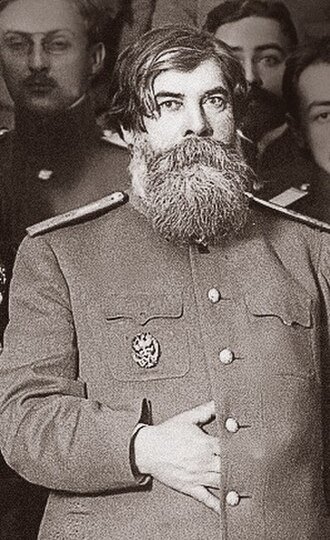
Vladimir Bekhterev
1857–1927 · Russian neurologist, neurophysiologist and psychiatrist, pioneer of objective psychology
Vladimir Bekhterev (1857-1927) was a Russian neurologist, neurophysiologist and psychiatrist who, independently of Ivan Pavlov, studied conditioned reflexes and helped shape objective psychology. His work sits at the boundary between nineteenth-century clinical medicine and the experimental psychology of the twentieth century, and he is remembered as one of the founders of scientific psychology in Russia.
Born in 1857 in Sorali, a village in the Vyatka Governorate of the Russian Empire, he lost his father, a district police officer, to tuberculosis while still a child. He trained at the Military Medical Academy in St Petersburg, where his interest in neuropathology and psychiatry was first sparked under Jan Mierzejewski. After graduating in 1878 and defending his doctoral thesis in 1881, he spent several years abroad, working with Wilhelm Wundt, Jean-Martin Charcot and Emil du Bois-Reymond.
Back in Russia he taught at the University of Kazan from 1885 to 1893 and founded the first Russian laboratory of experimental psychology there in 1886. It was during this period that he described ankylosing spondylitis, now also known as Bekhterev's disease, a degenerative arthritis of the spine. From 1893 to 1913 he headed the department of nervous and mental diseases at the Military Medical Academy in St Petersburg, and in 1907 he founded the Psychoneurological Institute. He also helped launch journals and scientific societies, and his publication output was considerable.
His central idea was that human behaviour could be explained by objectively studying reflexes, rather than by introspection. He distinguished inherited from acquired reflexes, and in «Suggestion and its Role in Social Life» he examined collective suggestion as distinct from hypnosis. His theory of energetic inhibition held that nervous activity concentrates in one centre, leaving other areas of the brain inhibited. Later work, such as «Collective Reflexology» (1921), tried to extend this approach to social groups.
From 1917 until his death he held the chair of psychiatry and reflexology at the University of Petrograd. He died in Moscow in December 1927. His legacy is recognised in the development of behaviourism and Soviet reflexology, although his rivalry with Pavlov and the circumstances of his death, which rumours linked to Stalin but which remain unproven, have kept his figure controversial.
Key ideas
- Objective psychology: behaviour can be studied through observable reflexes and traits, without relying on introspection.
- Conditioned reflexes: in parallel with Pavlov, he developed a theory of inherited and acquired reflexes.
- Energetic inhibition: nervous activity concentrates in one centre, leaving other areas of the brain inhibited.
- Collective reflexology: he proposed applying the study of reflexes to the behaviour of social groups.
Curiosities
Doctoral thesis
He defended his thesis in 1881 on body temperature in certain mental illnesses.
A disease named after him
Ankylosing spondylitis is also known as Bekhterev's disease, after his description of it in Kazan.
Teachers and influences
Teachers
- Wilhelm Wundt 1832–1920
Original Filopedia text based on Wikipedia (es) and Wikipedia (en) and Wikidata.