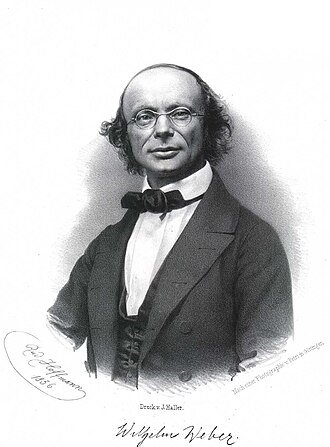
Wilhelm Eduard Weber
1804–1891 · German physicist, pioneer of electromagnetism and electrical units
Wilhelm Eduard Weber (1804-1891) was a German physicist who worked in Prussia and Hanover. He belonged to the generation that turned the study of electricity and magnetism into a quantitative science. Together with Carl Friedrich Gauss he built, in 1833, one of the first electromagnetic telegraphs, and the SI unit of magnetic flux, the weber, is named after him.
Born in 1804 in Wittenberg, he was the son of Michael Weber, a professor of theology. When the university there was dissolved, the family moved to Halle. Wilhelm, the middle of three brothers, was first taught by his father and then attended the orphanage and grammar school before entering university to study natural philosophy. Before turning twenty he co-wrote with his brother Ernst Heinrich, an anatomist, a book on wave theory and fluidity that earned both of them a considerable reputation. Acoustics remained his favourite subject, and his work on reed organ pipes at Halle drew the attention of Alexander von Humboldt and Gauss.
In 1831, on Gauss's recommendation, he was appointed professor of physics at Göttingen at the age of twenty-seven. His lectures were lively and thought-provoking, but he believed physics could not be learned from lectures alone. He urged students to experiment and gave them free use of the laboratory, which was unusual at the time. With Gauss he set up a telegraph linking the university laboratory with the observatory, about three kilometres away. In 1837 he was one of the Göttingen Seven, professors who refused to swear loyalty to the new king of Hanover after a constitutional change. Dismissed for his liberal views, he travelled, including to England, taught at Leipzig from 1843 to 1849, and then returned to Göttingen, where he eventually directed the observatory.
His best-known contribution is the unification of electrical units. He systematically repeated the quantitative experiments of Ørsted and Faraday, linked them to Gauss's magnetic measurements, and designed highly precise instruments such as the electrodynamometer. His aim was to do for electricity what Newton had done for mechanics: to connect its quantities in a single coherent system. In 1856, with Rudolf Kohlrausch, he found that the ratio of electrostatic to electromagnetic units matched the speed of light. This result encouraged Maxwell to propose that light is an electromagnetic wave, and Weber used it to develop his own electrodynamic theory. He was also the first to use the letter c for the speed of light, in a paper of that year. His geomagnetic work, including the Atlas des Erdmagnetismus made with Gauss, helped prompt the founding of magnetic observatories across the major powers.
Weber died in Göttingen in 1891, aged eighty-six. He had been a foreign member of the Royal Swedish Academy of Sciences since 1855. His influence reaches modern physics, metrology and the history of electromagnetism, which he helped turn into a measurable theory.
Key ideas
- Unification of electrical units: linking electricity, magnetism and mechanics through absolute, coherent measurements.
- Weberian electrodynamics: the force between moving charges depends on their relative velocity, tying electricity to the speed of light.
- Electricity and light: the ratio between electrostatic and electromagnetic units matches the speed of light, a key result for Maxwell's theory.
- Weber's law for reed pipes: approximate rules relating the frequency of sound to the length of the resonating tube.
- Learning by experiment: physics is better understood by doing it in the laboratory, not only by hearing it explained.
Curiosities
The Göttingen Seven
In 1837 he refused to swear loyalty to Hanover's new king, which cost him his university post.
A three-kilometre telegraph
The telegraph he built with Gauss linked the university laboratory with the observatory, about three kilometres away.
Teachers and influences
Pupils
- Gottlob Frege 1848–1925
Original Filopedia text based on Wikipedia (es) and Wikipedia (en) and Wikidata.