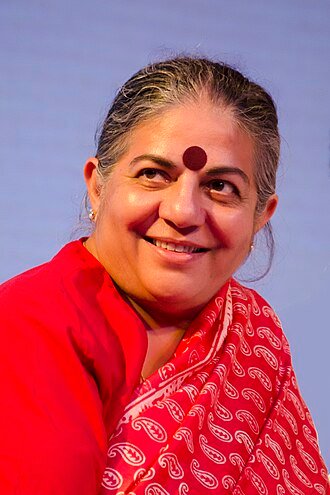
Vandana Shiva
b. 1952 · Indian physicist, philosopher and environmental activist
Vandana Shiva (born in Dehradun in 1952) is an Indian physicist, philosopher and activist, and one of the best-known voices in ecofeminism and in the movement against economic globalisation. Trained first in science, she has combined in her work reflections on science, agriculture and women's rights with direct action in defence of biodiversity. For this reason she is regarded as a central figure in contemporary environmental thought.
Her father was a forest conservator and her mother a farmer with a deep love of nature. She was schooled at convent institutions in Nainital and Dehradun and studied physics at Panjab University in Chandigarh, graduating in 1972. After a short spell at the Bhabha Atomic Research Centre she moved to Canada, where she took a master's degree in the philosophy of science at the University of Guelph and later a doctorate on hidden variables in quantum theory. In 1973 she took part in the Chipko movement, which opposed logging in the Himalayas through non-violent resistance. That experience shaped her view of the links between scientific knowledge, local communities and the environment. In 1982 she founded the Research Foundation for Science, Technology and Ecology, and in 1991 she launched Navdanya, a network of farmers and ecologists that preserves local seed varieties, promotes organic farming and has set up many community seed banks.
Her central ideas revolve around diversity as the basis of both life and economy. Shiva argues that industrial agriculture, built on commercial seeds, fertilisers and pesticides, impoverishes the soil, erodes biodiversity and leaves farmers dependent on a few corporations. She denounces biopiracy, the patenting of traditional plants and seeds such as neem and basmati rice, and defends seed freedom against international intellectual property agreements. From an ecofeminist standpoint, she holds that patriarchy has subordinated both nature and women, who have traditionally cared for life, and that care should sit at the centre of social and economic organisation. Drawing on Gandhi, she advocates non-violence and an idea of earth democracy as an alternative to globalised capitalism.
Her books include Staying Alive, The Violence of the Green Revolution and Earth Democracy. In 1993 she received the Right Livelihood Award, often called the Alternative Nobel Prize. Her influence is considerable in debates on organic farming, food sovereignty and anti-globalisation. She has advised governments and non-governmental organisations, although her positions, especially on genetically modified crops, have been disputed by many scientists.
Key ideas
- Diversity as the basis of life: a variety of seeds, crops and ecosystems underpins food and resilience in the face of crisis.
- Critique of industrial agriculture: monocultures, chemicals and patented seeds deplete the soil and make farmers dependent on a few companies.
- Seed freedom and biopiracy: patenting traditional natural resources amounts, in her view, to appropriating the knowledge of local communities.
- Ecofeminism: the domination of nature and the domination of women share a common root, and caring for life should guide the economy.
- Earth democracy: a non-violent, community-based alternative to globalised capitalism, inspired by Gandhi.
Works in Filopedia
Curiosities
The "Gandhi of grain"
Because of her campaigns against genetically modified crops, she is often called the "Gandhi of grain".
A short-lived ban
In 2021 she advised the government of Sri Lanka to ban inorganic fertilisers and pesticides. The ban was overturned seven months later, after a sharp fall in agricultural output.
Original Filopedia text based on Wikipedia (es) and Wikipedia (en) and Wikidata.