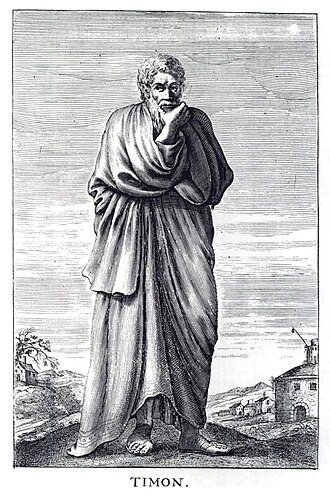
Timon of Phlius
319 BC–229 BC · Greek sceptic philosopher and satirical poet
Timon of Phlius, known as Timon the Silloi-writer, was a Greek philosopher of the Hellenistic period, born around 320 BC in Phlius, in the Peloponnese, and dying around 230 BC. He belongs to the sceptical tradition founded by Pyrrho, whose pupil he became. He matters chiefly because he gave philosophical doubt a satirical form and spread that attitude against the dogmatists of his day.
Most of what we know about his life comes from Diogenes Laertius. Orphaned while still young, he took up dancing before giving it up for philosophy. He studied with Stilpo in Megara, went back home to marry, and then moved with his wife to Elis to hear Pyrrho, whose views he adopted. Hard times drove him around the Hellespont and the Propontis, and in Chalcedon he taught philosophy and rhetoric with considerable success. He later settled in Athens, where he lived until his death apart from a brief stay in Thebes. According to Diogenes, he knew the kings Antigonus and Ptolemy II Philadelphus.
His best-known work is the Silloi, a satirical poem in three books written in hexameters. In it he mocks the doctrines of philosophers, both living and dead. The last two books take the form of a dialogue in which Timon asks questions and Xenophanes replies. Most of his writings, including poems, tragedies and a large body of prose, have been lost, and we know them mainly through fragments quoted by later authors.
His thought rests on the claim that things are indifferent, unstable and indeterminate, so that neither our senses nor our opinions can be called true or false. For this reason we should suspend judgement and lean toward no position, saying of anything that it is no more than it is not, or that it both is and is not, or that it neither is nor is not. This suspension of judgement became a central feature of scepticism.
After his death the school had no immediate successor until Ptolemy of Cyrene revived it. His pupils and the line of thinkers that followed, among them Aenesidemus and Sextus Empiricus, carried his sceptical legacy forward into later philosophy. Some scholars have even suggested that Pyrrhonism owes more to Timon than to Pyrrho himself.
Key ideas
- The indifference of things: things are not true or false in themselves but unstable and indeterminate.
- Distrust of senses and opinions: neither perception nor belief offers a secure criterion of truth.
- Suspension of judgement: the wise course is to hold no opinions and lean toward no dogmatic position.
- Satirical critique of dogmatism: the Silloi mock philosophers who claim to know how things really are.
Curiosities
A joke about eyesight
According to Diogenes Laertius, Timon was one-eyed and called himself "Cyclops". He told a man who marvelled at everything that, though there were three of them, they had only four eyes between them.
Reading without noticing
When reading his own poems aloud to the orator Zopyrus, he skipped several pages together, more than half the text, without noticing, and kept reading.
A question to Arcesilaus
Seeing Arcesilaus surrounded by chatterers and flatterers, he asked him: "What are you doing here, where we free men are?"
Teachers and influences
Teachers
- Pyrrho 360 BC–270 BC
Pupils
- Aratus 314 BC–239 BC
Original Filopedia text based on Wikipedia (es) and Wikipedia (en) and Wikidata.