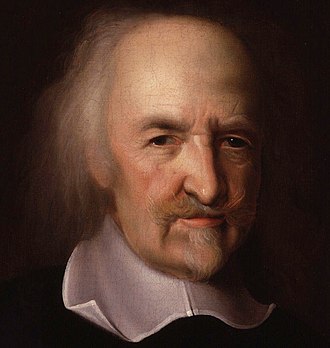
Thomas Hobbes
1588–1679 · English philosopher and political theorist, one of the founders of modern political philosophy
Thomas Hobbes (Westport, near Malmesbury, 1588 – Derbyshire, 1679) was an English philosopher whose work is usually regarded as the starting point of modern political philosophy. Living between the late Renaissance and the new science of the seventeenth century, he is best known for Leviathan (1651), which gives one of the most influential formulations of social contract theory. He also wrote on history, ethics, theology, geometry and physics, but his reputation rests on his account of why people accept submission to a common authority.
He was born on 5 April 1588, in the Old Style calendar. The story goes that he arrived prematurely, at the time when a Spanish invasion was feared, and later he joked that his mother had given birth to "twins: myself and fear". Little is known about his childhood. His father, a vicar, fell out with the local clergy and had to leave the area, so the boy was raised by a prosperous uncle who paid for a solid education. He studied in Malmesbury and at a private school, and at around fifteen entered Magdalen Hall, Oxford, where he found the scholastic curriculum uninspiring and preferred to read on his own.
His talent won him a place in the Cavendish household, where he worked as tutor and secretary for much of his life. He accompanied his pupil William on journeys through France, Italy and Germany, and there he came into contact with European scientific methods. He spent years on the classics and in 1628 published a translation of Thucydides's History of the Peloponnesian War, probably the first direct English translation from the Greek. Around 1630 he turned seriously to philosophy, partly through the Parisian circle around Marin Mersenne, where he debated with thinkers such as Descartes and Gassendi.
His philosophical project sought to explain all of reality in terms of matter in motion. He planned a treatise on bodies, another on human beings, focused on sensation, knowledge and the passions, and a last one on the state. In this picture people are driven mainly by fear and desire, and in the state of nature they live in a condition of war of all against all. To escape it, individuals hand over their rights to a sovereign who guarantees peace and security. Hobbes thus defended a strong, nearly absolute power, yet his starting points, natural human equality, the conventional character of the state and the idea that political authority is justified by the protection it provides, opened paths that later liberal thought would follow.
The English Civil War drove him into exile in Paris in 1640, where he wrote early political works such as The Elements of Law, which circulated in manuscript. He returned to England in 1651, the year he published Leviathan. His defence of monarchy earned him a pension from Charles II, though his materialism and his stance on religion made him many enemies, among them the Church of England and the University of Oxford. In 1666 his books were burned in England on charges of atheism, and after his death in 1679 they were burned again.
His influence is considerable. Leviathan remains a central reference in social contract theory, and notions such as the state of nature and the laws of nature are part of the common vocabulary of political philosophy. His mechanistic view of human beings and his account of cooperation grounded in self-interest anticipated debates that continue today.
Key ideas
- State of nature: without a common power, people live in constant distrust and competition, a "war of all against all".
- Social contract: peace becomes possible when individuals give up their rights to a sovereign who guarantees their security.
- Mechanistic materialism: everything that exists, including thought, emotion and desire, can be explained as matter in motion, with no immaterial soul.
- Natural equality: people are naturally equal in their capacity to harm one another, and this equality grounds political obligation.
- Sovereignty as protection: political power is conventional and is justified by the protection it gives its subjects, an idea that opened the way to representative legitimacy.
Books to read
- Leviathan EnglishEPUB 828 KBRead online
- The English works of Thomas Hobbes of Malmesbury, Volume 04 (of 11) EnglishEPUB 402 KBRead online
- The English works of Thomas Hobbes of Malmesbury, Volume 01 (of 11) EnglishEPUB 399 KBRead online
- The English works of Thomas Hobbes of Malmesbury, Volume 03 (of 11) EnglishEPUB 571 KBRead online
- The English works of Thomas Hobbes of Malmesbury, Volume 02 (of 11) EnglishEPUB 329 KBRead online
- The English works of Thomas Hobbes of Malmesbury, Volume 05 (of 11) EnglishEPUB 344 KBRead online
- The English works of Thomas Hobbes of Malmesbury, Volume 06 (of 11) EnglishEPUB 400 KBRead online
- The English works of Thomas Hobbes of Malmesbury, Volume 07 (of 11) EnglishEPUB 366 KBRead online
Curiosities
Child of fear
Hobbes joked that his mother gave birth to twins: himself and fear, a reference to the threat of the Spanish Armada at the time of his birth.
Books burned
In 1666 his books were burned in England on charges of atheism, and after his death the public burning was repeated.
Teachers and influences
Influenced by
- Aristotle 383 BC–321 BC
- Plato 428 BC–348 BC
- Francis Bacon 1561–1626
- Hugo Grotius 1583–1645
Influenced
- John Locke 1632–1704
- Gottfried Wilhelm Leibniz 1646–1716
- Benedictus de Spinoza 1632–1677
- Carl Schmitt 1888–1985
- Moses Mendelssohn 1729–1786
Original Filopedia text based on Wikipedia (es) and Wikipedia (en) and Wikidata.