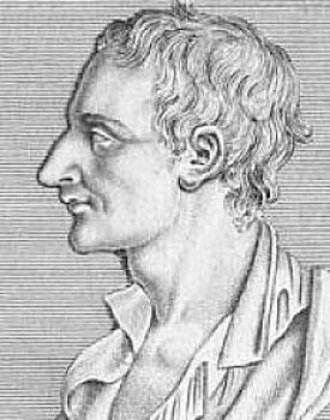
Sylvain Maréchal
1750–1803 · essayist, poet and atheist political theorist of the French Revolution
Sylvain Maréchal (Paris, 1750 – Montrouge, 1803) was a French essayist, poet and political theorist whose ideas anticipated utopian socialism and communism. Active in the late Enlightenment and during the Revolution, he is remembered above all for his demand for economic equality and for his outspoken atheism, rare in France at the time.
The son of a wine merchant, he studied law and qualified as a lawyer in Paris. At twenty he published a collection of idylls that earned him a post as assistant librarian at the Collège Mazarin. He admired Rousseau, Voltaire, Helvétius and Diderot, and moved among deist and atheist writers. His thought blended an agrarian socialism, in which all goods would be shared, with a critique of absolutism and of established religion. In his Fragments of a Moral Poem on God he proposed replacing Christian worship with a cult of Virtue and faith in Reason.
His satirical writings cost him dearly. His parody of the Bible, Book Salvaged from the Flood, together with his atheism, cost him his post at the college, and he had to live by his pen. In 1788 he was sentenced to four months in prison for publishing the Honest Man's Almanac, whose calendar replaced the saints with famous figures. From then on he published anonymously to avoid further prosecution.
He welcomed the Revolution and defended the poor, but grew uneasy as events turned, especially after the Thermidorian Reaction and the rise of the Directory. His link with François-Noël Babeuf drew him into the Conspiracy of the Equals, for which he wrote the Manifesto of the Equals (1796), calling for the abolition of private property and economic equality between men and women. In 1801 he published his Bill Forbidding the Teaching of Reading to Women, an ironic attack on the legislative sexism of Chaptal's education plan. It was long misread, and is now often seen as satire. He died at Montrouge in 1803.
His influence can be traced in later utopian socialism, which took up the vision of a society without private property. His Dictionary of Ancient and Modern Atheists is counted among the earliest reference works devoted to atheism.
Key ideas
- Agrarian socialism: land and goods would be held and shared by the community.
- Cult of Virtue and Reason: he proposed replacing Christian religion with a civic faith grounded in morality and reason.
- Atheism: he rejected God as an authority over human life, since believing in him meant submitting to hierarchy.
- Equality of the sexes: he defended economic equality and equal enjoyment of goods for men and women.
- Critique of absolutism: he saw arbitrary political power as another form of domination to be resisted.
Books to read
- La Femme Abbé FrenchEPUB 121 KBRead online
Curiosities
A calendar without saints
The Honest Man's Almanac replaced the saints with famous figures such as Blaise Pascal, which led to a four-month prison sentence in 1788.
A widely misread pamphlet
His Bill Forbidding the Teaching of Reading to Women was long read as a serious proposal, when it was in fact a satire of the legislative sexism of its time.
Original Filopedia text based on Wikipedia (es) and Wikipedia (en) and Wikidata.