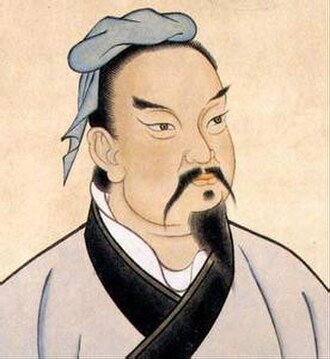
Sun Tzu
543 BC–495 BC · Chinese general, military strategist and philosopher
Origins and name
Sun Tzu, whose name means "Master Sun", is a figure whose historical existence remains debated. His birth name is recorded as Sun Wu, and outside his family he was known by the courtesy name Changqing. The earliest sources disagree about his birthplace: the Spring and Autumn Annals place him in Qi, while Sima Qian's Records of the Grand Historian make him a native of Qi.
The traditional biography
The main account of his life is the biography in the Records of the Grand Historian, written around 97 BC. According to it, Sun Tzu was hired by King Helü of Wu after demonstrating his skill. The king asked him to turn his 180 concubines into soldiers. Sun Tzu divided them into two companies under the king's two favourite concubines, but when he gave orders they laughed. Despite the king's protests, the strategist had the two favourites executed, after which the rest obeyed at once, and Sun Wu was appointed general. The story illustrates his rigour and his view that a general, once appointed, must carry out his mission even against the king's wishes.
Military career
Tradition holds that Sun Tzu led the forces of Wu to victory over the much larger state of Chu at the Battle of Boju in 506 BC. However, the Zuo Zhuan, an earlier text describing that battle in detail, never mentions him. Later sources connect him with Wu Zixu, a refugee from Chu credited with introducing Sun Wu to King Helü.
Doubts about his historicity
From the twelfth century onward, several Chinese scholars began to doubt his existence. Ye Shi (1150–1223) noted the silence of the Zuo Zhuan and the absence of the name Sun Wu from any text earlier than the Records of the Grand Historian. The name may be a descriptive epithet, since "Sun" relates to the idea of a fugitive and "Wu" to martial valour. The Art of War also contains anachronisms in its terms, technology, philosophical ideas and military techniques that would not have existed in the period assigned to him. Sawyer, however, argues that Sun Tzu very probably existed and wrote the core of the book, which was afterwards transmitted by his family or by disciples.
The Art of War
The work traditionally ascribed to Sun Tzu consists of thirteen chapters, each devoted to an aspect of warfare and its application to strategy and tactics. Scholars now date it to the beginning of the Warring States period. A 1972 archaeological discovery at Yinqueshan in Shandong produced bamboo-slip texts from the mid-second century BC that contain much of its content, confirming its early composition. The same site yielded Sun Bin's Military Methods, a work attributed to a descendant and closely related to the Art of War. The book does not deal only with battles: it upholds diplomacy and the cultivation of relations with other states as essential to a state's health. Its sober, paradoxical style draws on Taoist imagery and seeks effectiveness through economy of means and avoidance of direct confrontation.
Reception and transmission
The book was one of the most widely read works in the Warring States period. Under the Song dynasty it was gathered with six other military texts into the Seven Military Classics, of which it was the central piece. For centuries it was required reading in the examinations for military posts. The general and strategist Cao Cao wrote the earliest surviving commentary around the third century, and in the twelfth century Ji Tianbao compiled numerous later commentaries by different authors.
Influence in Asia and the West
The book reached Japan around 760 AD and was highly valued by samurai and by the great unifiers of the country, including Oda Nobunaga, Toyotomi Hideyoshi and Tokugawa Ieyasu. Tōgō Heihachirō, who led Japan's fleet in the Russo-Japanese War, was an avid reader. In the West, a French translation appeared in 1772 and an annotated English version by Lionel Giles in 1910. Mao Zedong and Võ Nguyên Giáp drew on its ideas, and the United States Army included it in its reading programmes. Today its reach extends to politics, business and sport.
Key ideas
- Winning without fighting: the best victory is the one achieved by avoiding direct confrontation.
- Knowing oneself and the enemy: preparation depends on an honest assessment of both your own strengths and those of your opponent.
- Terrain and information: position and prior knowledge often decide the outcome of a conflict.
- The general's authority: once appointed, a commander must exercise command with discipline and without yielding to outside pressure.
Works in Filopedia
Books to read
Curiosities
The royal concubines
The story of the 180 concubines appears in the Records of the Grand Historian, but it is regarded as legendary because the execution seems improbable.
A 1972 discovery
In 1972, bamboo slips found at Yinque Shan in Shandong contained a treatise by Sun Bin, which made it possible to tell him apart from Sun Tzu.
Teachers and influences
Influenced
- Robert Greene b. 1959
Original Filopedia text based on Wikipedia (es) and Wikipedia (en) and Wikidata.