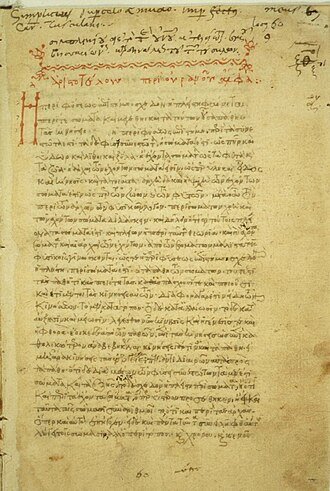
Simplicius of Cilicia
480–560 · Neoplatonist philosopher and mathematician of late antiquity
Simplicius of Cilicia was a Neoplatonist philosopher and mathematician of late antiquity, active in the Greek-speaking world under Byzantine rule. He is often regarded as one of the last great thinkers of the pagan philosophical tradition. His importance rests largely on his commentaries on Aristotle, which preserve a great deal of information about earlier philosophers that would otherwise have been lost.
He trained first with Ammonius Hermiae in Alexandria and later with Damascius in Athens, where the Neoplatonist school remained active until Emperor Justinian ordered its closure in 529. Like several of his colleagues, he left the Empire. One account places him in Harran, in Persian-ruled territory, where he worked alongside Damascius, but the evidence is uncertain. Dates for his life vary: his birth is usually placed around 480 or 490, and his death around 540 or 560. Almost everything we know about him comes from his own writings, which say little about his exile.
His thought aimed to reconcile Plato and Aristotle. He argued that their differences were mostly a matter of wording, and he read Plato's notion of non-being as corresponding to Aristotle's matter. From Aristotle he took the idea of an active intellect separate from the individual. His ethics leans toward late Stoicism, although he rejected the materialism of the Stoics. In astronomy he held that Aristotelian cosmology should be presented as a deductive system, and he criticised John Philoponus for restricting the use of mathematics in physics. His main works are commentaries on Aristotle's Physics, On the Heavens and On the Soul, and on Epictetus's Enchiridion. His chief legacy is as a transmitter: much of what survives of Parmenides' poem is preserved thanks largely to him and to Sextus Empiricus.
Key ideas
- Harmony of Plato and Aristotle. He held that the two agreed in essentials and that many of their disagreements concerned formulation rather than substance.
- The active intellect. He took from Aristotle the notion of an active intellect separate from the individual.
- Deductive method in astronomy. He defended the unrestricted application of mathematics to physics and astronomy.
- Stoic-leaning ethics. His ethics drew close to late Stoicism, though he rejected Stoic materialism.
Curiosities
A disappointing journey to Persia
According to the sources, he and six other Neoplatonists set out for Persia, drawn by the reputation of Khosrow I as a philosopher king. They were disappointed and returned, though a peace treaty around 533 allowed them to come back and practise their rites.
A commentary published centuries later
His commentary on Aristotle's Categories was published in Venice in 1499, long after his death, helping to spread his work in Renaissance Europe.
Original Filopedia text based on Wikipedia (es) and Wikipedia (en) and Wikidata.