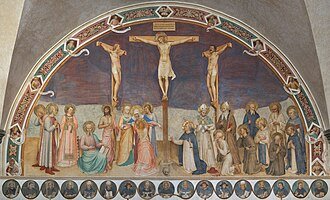
Pseudo-Dionysius the Areopagite
500–600 · Byzantine theologian and mystic
Pseudo-Dionysius the Areopagite was a Byzantine theologian and mystic, probably of Syrian origin, who wrote between the late fifth and early sixth centuries. His importance lies in bridging Neoplatonism and Christian theology, and in being regarded as the originator of negative theology, the path that holds we cannot say what God is, only what God is not.
The name is a later attribution. His writings present themselves as the work of Dionysius, the Athenian convert of Paul mentioned in the Acts of the Apostles, and this claim to apostolic authorship caused centuries of confusion that was not resolved until Lorenzo Valla and Erasmus questioned the traditional attribution. In 1895, the philological work of J. Stiglmayr and H. Koch showed that the corpus depended on the Neoplatonist philosopher Proclus, and from then on he has been known as pseudo-Dionysius. His real identity remains unresolved. His surviving works include The Divine Names, Mystical Theology, The Celestial Hierarchy, The Ecclesiastical Hierarchy and ten letters. In the Celestial Hierarchy he describes angels grouped into three triads of three orders each, while in the Ecclesiastical Hierarchy he applies the same scheme to the sacraments and to the grades of clergy and laity.
His influence was immense. John Scotus Eriugena translated him into Latin in the ninth century, and his negative theology shaped medieval mysticism and Scholasticism, as well as later Christian asceticism and the quietism of Miguel de Molinos. During the Reformation, Martin Luther cited him ambiguously: at times he rejected him, especially as his opponents used him, such as Johann Eck, yet at other times he drew heavily on him, largely through German mystics. The idea of a hidden God whom human reason cannot reach is a direct inheritance from this anonymous author.
Key ideas
- Negative theology: we can say only what God is not, because the divine essence exceeds every human concept.
- Mystical union: the soul rises toward God, leaving rational knowledge behind in a union that surpasses understanding.
- Celestial hierarchy: the order of angels is arranged in three triads of three choirs each, and the Church mirrors this order in its sacraments and ranks.
- Christian Neoplatonism: he adapts the thought of Proclus to the Christian faith, intending to remain faithful to it.
Works in Filopedia
Curiosities
A borrowed identity
For centuries his works were credited to Dionysius the Areopagite, an Athenian converted by Paul according to the Acts of the Apostles.
A debate with Luther
In 1519, at Leipzig, Johann Eck used these writings to defend the apostolic origin of papal primacy against Luther.
Valla's doubt
In 1457, the Florentine humanist Lorenzo Valla showed that the author could not be Paul's convert, though he could not identify the real writer.
Original Filopedia text based on Wikipedia (es) and Wikipedia (en) and Wikidata.