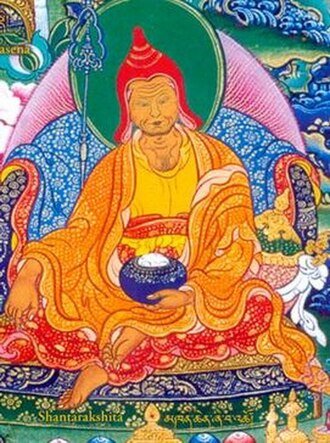
Śāntarakṣita
725–788 · Indian Buddhist philosopher of the Madhyamaka school
Śāntarakṣita (c. 725–788) was an Indian Buddhist philosopher of the Madhyamaka school and a pivotal figure for Tibetan Buddhism. He lived during the Pala Empire and, together with Padmasambhava and his disciple Kamalaśīla, is regarded as one of the first to establish Buddhism in Tibet. His lasting importance lies in the synthesis of philosophical traditions he proposed, which still shapes Tibetan thought.
The biographical record is thin and largely hagiographic. According to tradition, he studied with Jñānagarbha and rose to become abbot of Nalanda. Invited by King Trisong Detsen, he first attempted to establish a Buddhist community in Tibet around 763, but the effort failed amid resistance from local spirits, and he spent about six years in Nepal before returning. With the help of Padmasambhava, who performed the rites needed to calm those spirits, the monastery of Samye was begun around 775 on the model of Uddaṇḍapura. There he ordained the first Tibetan monastics, set up a monastic curriculum based on Indian practice, and oversaw the translation of Buddhist texts.
His thought blends Madhyamaka with Yogācāra and the logic of Dharmakīrti. For him, ultimate truth is the emptiness of any inherent nature, which he argues through the "neither one nor many" reasoning: no phenomenon can have an essence that is either singular or plural, so none has an essence at all. On the conventional level, however, he accepts Yogācāra teachings such as mind-only. His main work, the Madhyamakālaṃkāra and its auto-commentary, sets out this view and arranges the Buddhist schools in a hierarchy that Tibetan thinkers later adopted.
His influence endured in Tibet, where he is counted among the so-called three Eastern Svātantrikas. He is often seen as the last great synthesizer of Indian Buddhist philosophy before Buddhism disappeared from India.
Key ideas
- Emptiness: nothing possesses an independent, inherent nature, and this is the ultimate truth.
- Neither one nor many: no phenomenon can have a singular or a plural nature, so it lacks any essence.
- Two truths: the ultimate truth is emptiness, while the conventional is what functions causally, changes, and is known by the mind.
- Synthesis of views: Madhyamaka can be combined with Yogācāra and Dharmakīrti's logic without contradiction.
- Doctrinal hierarchy: the lower Buddhist schools serve as steps toward the most accurate Madhyamaka view.
Curiosities
A failed first journey
According to Tibetan sources, his first arrival in Tibet failed because of local spirits, and he was forced to leave, spending about six years in Nepal.
An accidental death
Tibetan sources state that he died suddenly after being kicked by a horse.
A king's son
According to the commentator Ju Mipham, he was the son of the king of Zahor, a region some place near Bhagalpur in eastern Bihar.
Original Filopedia text based on Wikipedia (es) and Wikipedia (en) and Wikidata.