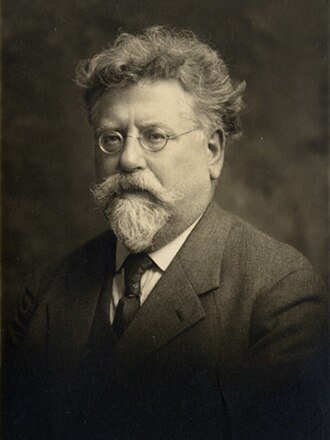
Johann Rudolf Rocker (Mainz, 1873 - near New York, 1958) was a German anarcho-syndicalist, writer and activist. His life took him through Germany, London and the United States, and his work among Yiddish-speaking workers made him a notable figure in the anarchism of the first half of the twentieth century.
He lost both parents while still young, spent time in a Catholic orphanage and ran away from it twice, later working as a cabin boy on river boats. He then trained as a typographer, influenced by his uncle Carl Rudolf Naumann, a socialist with a sizeable library. Rocker joined the German Social Democratic Party, but was expelled in 1891 together with the youth opposition known as Die Jungen. After the socialist congress in Brussels that year, he became convinced by anarchist ideas, reading Bakunin and Kropotkin. Facing persecution for his activism, he fled to Paris in 1893 and settled in London in 1895, where he joined the Jewish anarchist circles of the East End. There he met Milly Witkop, who became his partner for life. In 1897 he emigrated to New York.
Rocker admired Bakunin's fiery style, but his thinking owes more to Kropotkin's orderly argument. He wanted to persuade readers, not only to stir them. In the 1920s he helped found the syndicalist Free Workers' Union of Germany (FAUD) and the International Workers' Association (IWA). Alarmed by the rise of nationalism and fascism, he left Germany in 1933 for the United States, where he worked in libertarian education and in solidarity with the Spanish Revolution. After the war he wrote about the history of libertarian ideas in America, aiming to show that radical thought was not a foreign import.
His legacy rests chiefly on his critique of nationalism as a cultural construction and on his studies of anarcho-syndicalism, which remain standard reading in libertarian circles.
Key works
- Nationalism and Culture (1937): an essay on nationalism as a cultural and political force and its threat to freedom.
- Anarcho-Syndicalism (1938): an account of revolutionary syndicalism as a way of organising workers without the state.
- Pioneers of American Freedom (1949): a survey of liberal and libertarian thought in the history of the United States.
Where to start
Anarcho-Syndicalism 1938
Anarcosyndicalism offers a clear introduction to the doctrine and practice that Rocker championed. It explains what anarcho-syndicalism is, how workers' direct action is organized, and why it rejects the State and centralized power, while also tracing the history of anarchist ideas and the European labour movement. It is a good starting point for a reader without specialist training.
Next: Nationalism and Culture. Nationalism and Culture broadens Rocker's outlook toward identity, power and culture, revealing the theoretical foundations of his libertarian critique.
Works in Filopedia
Curiosities
Escape from the orphanage
Tired of the obedience demanded by the Catholic orphanage, he ran away twice. The first time he spent three nights in the woods around Mainz.
Flight after a rally
After a speech to unemployed workers in 1892, the police broke up the meeting and arrested the speaker who followed him. Rocker escaped and decided to leave Germany.
Original Filopedia text based on Wikipedia (es) and Wikipedia (en) and Wikidata.