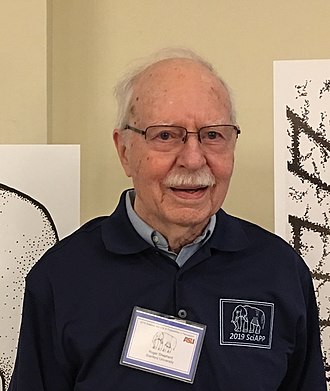
Roger Shepard (Palo Alto, 1929 – 2022) was an American cognitive psychologist often regarded as a pioneer of research into spatial relations in the mind. His work spanned learning theory, the mental representation of the world and perception, and it remains a reference point for understanding how the brain organizes information.
The son of a materials science professor at Stanford, he studied psychology there and earned his doctorate at Yale in 1955. He then worked at Bell Labs and taught at Harvard before joining Stanford, where he became Ray Lyman Wilbur Professor Emeritus of Social Science. In 1997 he co-founded the Kira Institute.
His starting point was generalization: the tendency of an organism to respond similarly to similar stimuli. In 1987 he proposed a universal law of generalization, according to which the response falls off exponentially as the psychological distance between stimuli grows. He also developed non-metric multidimensional scaling, a technique that turns judgments of similarity into a graphic map, later refined with Joseph Kruskal. In 1968 he began studying mental rotation, how we picture an object turning in space, and his work with Jacqueline Metzler measured how long people took to do it.
Shepard is also known for optical and auditory illusions, such as the Shepard table and the Shepard tones, which seem to rise endlessly in pitch. He received the National Medal of Science in 1995 and the Rumelhart Prize in 2006. His influence is felt across cognitive psychology and the study of spatial perception.
Key ideas
- Universal law of generalization: the response to a stimulus decreases exponentially as its psychological distance from a known one increases.
- Non-metric multidimensional scaling: a method that maps similarity relations between objects in a graphic space using ordered judgments.
- Mental rotation: the ability to imagine how an object looks when turned, measurable through response time.
- Perceptual illusions: exploration of visual and auditory ambiguities, such as the Shepard table and Shepard tones.
Curiosities
A dream about rotating objects
According to his account, the idea of studying mental rotation came from a dream of three-dimensional objects turning in space.
From Bell Labs computers to illusions
His early research on auditory illusions began at Bell Labs, where his colleague Max Mathews was experimenting with computer music synthesis.
Teachers and influences
Pupils
- Geoffrey F. Miller b. 1965
- Daniel Levitin b. 1957
Original Filopedia text based on Wikipedia (en) and Wikidata.