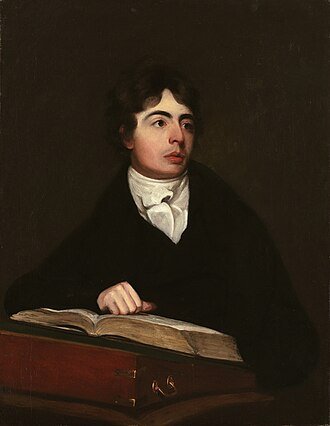
Robert Southey
1774–1843 · English poet, biographer and Hispanist
Robert Southey (Bristol, 1774 – Keswick, 1843) was an English poet of the Romantic school and one of the so-called Lake Poets, alongside William Wordsworth and Samuel Taylor Coleridge. He was appointed Poet Laureate in 1813. Today he is remembered as much for his prose as for his verse: he was a prolific biographer, historian and translator, with a particular interest in Spain and Portugal.
Born into a family of cloth merchants, he was raised for much of his childhood by an aunt. At Westminster School in London he was expelled after writing an article, in a magazine he had started himself, that blamed the Devil for inventing flogging. At Balliol College, Oxford, he spent more time reading German and French literature than attending lectures, and he left without a degree. There he befriended Coleridge, and the two planned an idealistic community called “pantisocracy”, which never came into being. Both men married sisters, and in 1803 Southey settled in the Lake District.
As a young man he was an enthusiast for the French Revolution, but over the years he moved towards Tory conservatism, earning the scorn of former allies such as Hazlitt and Byron. Byron mocked him in the dedication of Don Juan and in The Vision of Judgment, a parody of Southey's own poem praising George III. Southey was not a simple reactionary, however: he criticised child labour in the factories and supported universal free education.
He wrote constantly, partly because he depended on commissions from publishers and from the Quarterly Review. His output included epics on exotic subjects, histories, travel books and translations from Spanish and Portuguese, among them Amadis of Gaul and the Chronicle of the Cid. His biographies of Nelson, Wesley, Cromwell and Bunyan remained in circulation long after his death. Even his rivals praised the clarity of his prose, and British schoolchildren still encounter his short poems, such as “After Blenheim”. He died in Keswick in 1843.
Key works
- Joan of Arc (1796), an epic poem.
- The Curse of Kehama (1810), an epic based on an Indian legend.
- Thalaba the Destroyer (1801), an epic on an Arabic theme.
- Roderick, the Last of the Goths (1814), a heroic poem on the legend of King Roderick.
Books to read
- The Life of Horatio, Lord Nelson EnglishEPUB 296 KBRead online
- History of the Peninsular War, Volume 2 (of 6) EnglishEPUB 434 KBRead online
- History of the Peninsular War, Volume 5 (of 6) EnglishEPUB 477 KBRead online
- History of the Peninsular War, Volume 4 (of 6) EnglishEPUB 435 KBRead online
- History of the Peninsular War, Volume 1 (of 6) EnglishEPUB 428 KBRead online
- History of the Peninsular War, Volume 3 (of 6) EnglishEPUB 429 KBRead online
Curiosities
Expelled over an article
At Westminster School he was expelled for an article in a magazine he had founded, which attributed the invention of flogging to the Devil.
The Colossus of Roads
In 1819 Southey toured Scotland with the engineer Thomas Telford, whom he nicknamed the “Colossus of Roads”.
Original Filopedia text based on Wikipedia (es) and Wikipedia (en) and Wikidata.