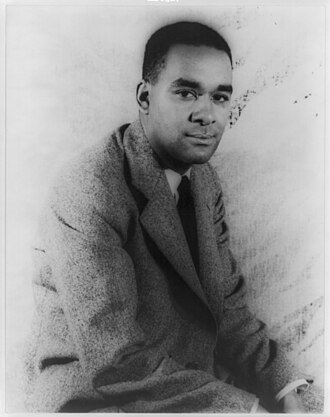
Richard Wright
1908–1960 · American novelist, short story writer and essayist
Richard Nathaniel Wright (Roxie, Mississippi, 1908 - Paris, 1960) was an American novelist, short story writer, poet and essayist. His work centres on the lives of African Americans from the late nineteenth century to the mid-twentieth, and he is regarded as one of the writers who helped reshape public debate about race relations in the United States.
He was born on a plantation in rural Mississippi, the son of a sharecropper who could not read and a schoolteacher. The family moved through Tennessee, Mississippi and Arkansas, partly to escape violence and instability. His childhood and adolescence, marked by poverty, the strict religious discipline of his relatives and irregular schooling, left him with a lasting distrust of everyday racism and of religious answers to social problems. In 1927 he settled in Chicago, where he worked as a postal clerk and taught himself to write by reading widely.
In the 1930s he joined the Communist Party, wrote proletarian poetry and contributed to left-wing magazines. The relationship proved strained. His disagreements with the party and some of its leaders ended in a public break, which he later described in the essay I Tried to Be a Communist (1944). In 1937 he moved to New York, where he worked for the Daily Worker and won a prize from Story magazine for his story Fire and Cloud.
His collection Uncle Tom's Children (1938) brought him national attention. The novel Native Son (1940), about a young Black man in Chicago who commits a murder and faces a system that sees him only as a threat, became both a bestseller and a critical success. Black Boy (1945), his memoir of childhood and youth in the South, is probably his most widely read book. He later settled in Paris, where he died in 1960.
His legacy lies in bringing a direct view of racial violence and exclusion into American literature at a time when few Black authors reached a wide readership. His books influenced later generations of writers, including Ralph Ellison, with whom he maintained a friendship that lasted for years.
Key works
- Uncle Tom's Children (1938), a collection of stories about racial violence in the rural South.
- Native Son (1940), a novel about a young Black man in Chicago and the consequences of his crime.
- Black Boy (1945), an autobiography of his childhood and youth in the South.
Where to start
Black Boy 1945
Black Boy is Richard Wright's 1945 autobiography. It recounts his childhood and youth in the segregated American South, shaped by poverty, racial violence and his hunger to learn and escape. It is a direct, accessible read that shows where his whole body of work comes from.
Next: Native Son. After knowing his life, Native Son (1940) will show how Wright turns the experience of discrimination into a novel denouncing racism in 1930s Chicago.
Works in Filopedia
- Uncle Tom's Children 1938
- Native Son 1940
- Black Boy 1945
- The Outsider 1953
Curiosities
A lost first story
His first story, The Voodoo of Hell's Half-Acre, was published in a local newspaper when he was fifteen. No copies of it survive.
A rejected novel
His first novel, completed in 1935, was turned down by eight publishers and appeared only after his death in 1963, under the title Lawd Today.
Forbidden reading
In Memphis, to borrow books reserved for white readers, he used a library card lent by a white coworker and forged notes claiming he was collecting books for that man.
Teachers and influences
Influenced by
- Sinclair Lewis 1885–1951
- Gertrude Stein 1874–1946
Influenced
- Gwendolyn Brooks 1917–2000
Original Filopedia text based on Wikipedia (es) and Wikipedia (en) and Wikidata.