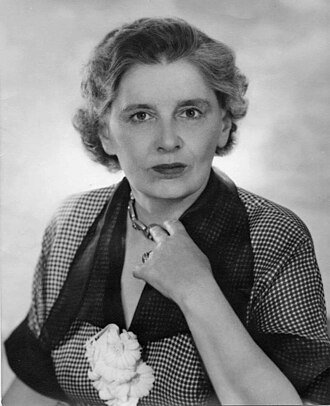
Rebecca West
1892–1983 · British author, journalist and literary critic
Rebecca West, born Cecily Isabel Fairfield in London in 1892 and dying in the same city in 1983, was a British author, journalist, literary critic and travel writer who worked across nearly every genre, from the novel and the essay to reportage and the travel book. She wrote in English, and her career spans most of the twentieth century, from the suffrage campaigns before the First World War to the postwar trials and the Cold War. Her significance lies in joining literary ideas to hard-edged reporting at a time when few women held such positions.
The name that made her known was a pseudonym taken from the rebellious heroine of Ibsen's Rosmersholm. She grew up in a household full of books, music and political argument. Her father, a gifted journalist with poor financial sense, abandoned the family when she was a child and died in poverty in Liverpool in 1906. After a bout of tuberculosis she left her school in Edinburgh in 1907, and much of her education came from her own reading. She trained briefly as an actress, but journalism soon became her main outlet, and she wrote for feminist and socialist papers while taking part in the suffrage movement.
In 1912 a sharp review of H. G. Wells drew his attention, and soon they began a relationship that produced a son, Anthony West, born in 1914. The affair lasted about ten years, while the friendship continued until Wells died in 1946. In 1930 she married the banker Henry Maxwell Andrews, and they stayed nominally together until his death in 1968.
Her fiction moved through different registers. The Return of the Soldier (1918) is a modernist novel about shell-shock and the return from the front, and The Judge (1922) takes up rape and the plight of unmarried mothers from a feminist standpoint. Among her non-fiction, Black Lamb and Grey Falcon (1941) stands out: it grew out of her trips to Yugoslavia in the 1930s and mixes travel, history and political reflection. After the Second World War she reported on the Nuremberg trials and on the treason trials in Britain, producing books such as A Train of Powder and The Meaning of Treason. During the Spanish Civil War she backed the Popular Front and helped aid Spanish women and children. Her criticism of communism after 1945 led some to accuse her of McCarthyism, which she denied.
Her legacy lies chiefly in the blend of literature and political reportage, and in her insistence on women's intellectual independence. Parts of her work were adapted for television and film, and she is still studied as a writer who moved with ease between the novel, the essay and the chronicle of her age.
Key works
- The Return of the Soldier (1918), a novel about a shell-shocked soldier and the collision with his past.
- The Judge (1922), a feminist novel about rape and unmarried motherhood.
- Black Lamb and Grey Falcon (1941), a travel book and essay on Yugoslavia and European history.
- A Train of Powder (1955), her reports on the Nuremberg trials.
- The Fountain Overflows (1956), an autobiographical novel about her childhood in Edinburgh.
Books to read
- The Return of the Soldier EnglishGutenberg
Curiosities
A name from Ibsen
She took her pseudonym from the rebellious heroine of Ibsen's *Rosmersholm*. She reportedly adopted it while training as an actress.
A sister who became a doctor
Her older sister Letitia became one of the first fully qualified female doctors in Britain.
Original Filopedia text based on Wikipedia (es) and Wikipedia (en) and Wikidata.