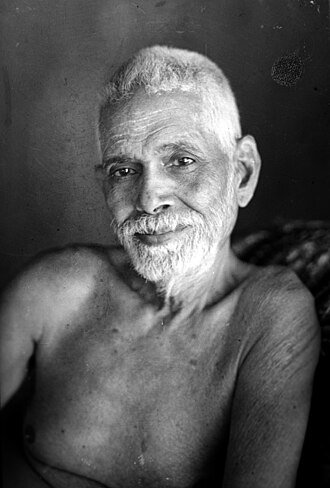
Ramana Maharshi
1879–1922 · Indian Hindu sage and Advaita Vedanta teacher
Venkataraman Iyer, known as Ramana Maharshi (Tiruchuzhi, 1879 – Tiruvannamalai, 1950), was one of the best-known Hindu spiritual teachers of his time. He belonged to the Advaita Vedanta tradition, which holds that ultimate reality is not two: the individual soul and the absolute are not separate things. His importance lies in placing direct experience of the Self at the centre of his teaching, rather than in an elaborate doctrine.
He was born into an orthodox Smarta Brahmin family in southern India. His father died in 1892, and the family scattered; he went to live with an uncle in Madurai. He had a remarkable memory, but his interest in school faded. Around 1895 he learned that the hill of Arunachala, linked to the god Shiva, was a real place, and reading the Periya Puranam, which tells the lives of the Shaiva saints, stirred a religious longing he had not felt before.
In 1896, at around sixteen or seventeen according to different accounts, he went through what he later called a death experience. Convinced he was dying, he lay down and asked himself what it was that was dying. He concluded that the body dies but something within him remained, and he recognised this as his true Self, which he later identified with Iswara, the personal God. He insisted he had undergone no prior ascetic preparation, and called this sudden liberation, in contrast to the gradual liberation of the jnana yoga path. Soon after, he left home and reached Tiruvannamalai, where he spent the rest of his life.
He first lived in temples and, from 1899, in caves on the slopes of Arunachala. Devotees who saw him as a manifestation of Shiva gathered around him to receive darshan, the sight of the sacred. Over time an ashram grew up, where teaching often happened in silence, sitting with visitors, or through answers to their questions.
His central practice was atma-vichara, self-enquiry: asking where the sense of 'I' arises, until the identification with body and mind dissolves and awareness of the Self remains. Although he regarded this as the principal means, he did not reject other paths and recommended combining it with devotion and surrender to the Self. He held that realisation does not come through willed effort, but emerges when the desire to act ceases and one remains still and silent.
His influence spread from the 1930s, when his teachings began reaching the West through visitors and writers such as Paul Brunton and Arthur Osborne. He is counted, alongside Sri Aurobindo and Paramahansa Yogananda, among the best-known Hindu religious figures of the twentieth century, and his ashram in Tiruvannamalai remains active.
Key ideas
- Atma-vichara (self-enquiry): asking where the sense of 'I' arises, until identification with body and mind dissolves.
- Advaita (non-duality): the individual soul and the absolute are not separate realities.
- Sudden liberation (akrama mukti): understanding can arrive all at once, without long preparation.
- Devotion and surrender: self-enquiry is completed by bhakti and surrender to the Self, without rejecting other paths.
Curiosities
Deep sleep
According to his biographer Narasimha, he slept so deeply that loud noises did not wake him, not even when others struck his body.
Prodigious memory
He could recall what he heard only once and used this ability to memorise Tamil poems.
Not eating
During his first months at the Arunachaleshvara temple he hardly ate, although food was left beside him.
Teachers and influences
Influenced
- Ken Wilber b. 1949
Original Filopedia text based on Wikipedia (es) and Wikipedia (en) and Wikidata.