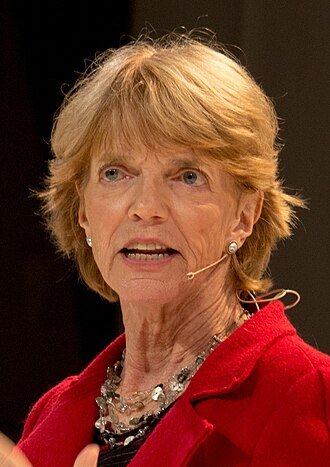
Patricia Churchland
b. 1943 · Canadian-American analytic philosopher of mind and neurophilosopher
Patricia Smith Churchland (born 16 July 1943 in Oliver, British Columbia) is a Canadian-American philosopher best known for her work on neurophilosophy and the philosophy of mind. She has argued that questions traditionally handled from the armchair cannot be settled well without understanding how the brain works. She has taught at the University of California, San Diego since 1984, and has held an adjunct professorship at the Salk Institute since 1989.
She grew up on a farm in the South Okanagan valley. Neither of her parents had finished high school, yet they valued learning and held a secular view of the world, and they pushed her toward college. She studied at the University of British Columbia, the University of Pittsburgh and Somerville College, Oxford, where she completed her B.Phil. in 1969. That year she began teaching at the University of Manitoba, where she started a serious study of neuroscience. She moved to San Diego in 1984 with her husband, the philosopher Paul Churchland, and received a MacArthur Fellowship in 1991.
Her first major book, Neurophilosophy: Toward a Unified Science of the Mind-Brain (1986), proposes a single scientific account of mind and brain, in which everyday psychological concepts must answer to what neuroscience reveals. With Terrence Sejnowski she wrote The Computational Brain (1992). Later books such as Braintrust (2011) and Conscience (2019) explore morality, choice and responsibility in terms of brain function, evolution and the interplay between brain and culture.
She is closely associated with eliminative materialism, the view that folk concepts such as belief, free will and consciousness may need to be revised, or dropped, as neuroscience advances. Her influence reaches philosophy of mind, neuroethics and debates about consciousness and morality, and she remains a central reference for those who want philosophy to engage closely with science.
Key ideas
- Mind-brain unity: understanding the mind requires understanding the brain, so philosophy of mind should draw on neuroscience.
- Eliminative materialism: folk concepts such as belief, free will and consciousness may need to be revised or abandoned as brain science progresses.
- Coevolution of the sciences: less developed disciplines are likely to be reshaped by more complete ones, which here means neuroscience.
- Naturalism: scientific research is the best route to understanding the nature of the mind.
- Neuroethics: choice, responsibility and moral norms can be explained in terms of brain function, evolution and brain-culture interaction.
Curiosities
A philosophical marriage
She met her husband, Paul Churchland, in a class on Plato at the University of Pittsburgh. Their work is so similar that they are sometimes discussed as one person.
A farm and a family without degrees
She grew up on a farm in the Okanagan valley. Neither parent finished high school, but they insisted she attend college, though many neighbours thought it a waste of money.
Teachers and influences
Influenced by
- Willard Van Orman Quine 1908–2000
- Paul Feyerabend 1924–1994
- Richard Rorty 1931–2007
- Wilfrid Sellars 1912–1989
Original Filopedia text based on Wikipedia (es) and Wikipedia (en) and Wikidata.